You downloaded a running app on a Sunday night, feeling genuinely inspired. You set a goal, picked a playlist, and went to bed excited. Monday’s run happened. Tuesday’s run happened. By Thursday you were bargaining with yourself, and by the following Wednesday the app had sent you three sad little notification badges that you immediately dismissed. Sound familiar? You are not lazy. You are not lacking discipline. You are just human, and humans are spectacularly bad at sustaining motivation for activities whose rewards live entirely in the abstract future.
This is where gamification enters the conversation, and not in the shallow “badges are fun” way that fitness brands love to throw around. Real gamification, applied thoughtfully to something like running, rewires the reward loop at a psychological level. For Gen Z and millennials especially, who grew up inside feedback-rich digital environments, this is not just a nice bonus. It is the difference between a three-day streak and a three-month habit.
🧠 Why Your Brain Keeps Quitting (And It’s Not a Willpower Problem)
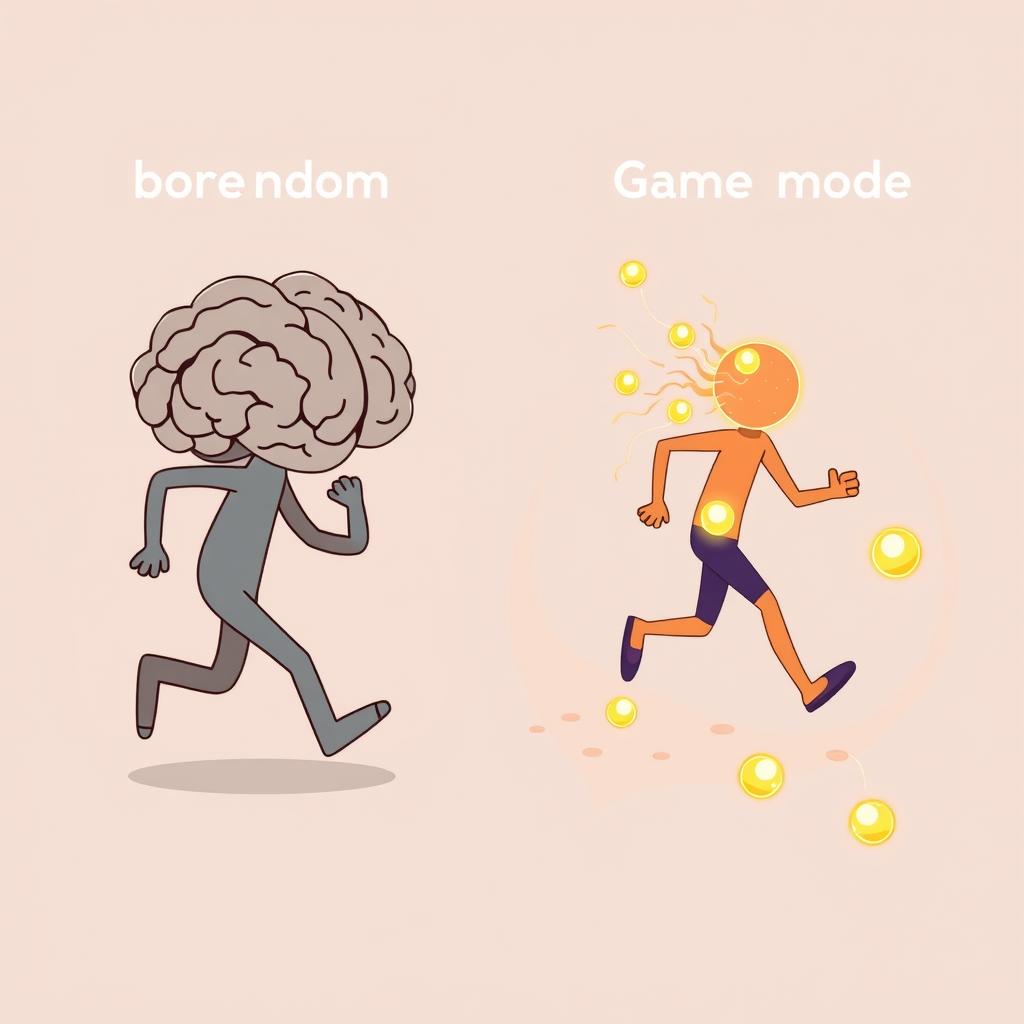
The human brain is an optimization machine, and it is ruthlessly logical about effort versus reward. Running, especially when you are just starting out, is physically uncomfortable, socially invisible, and staggeringly slow to produce results you can actually see or feel. The dopamine hit you get from finishing a run is modest and delayed. Compare that to literally anything else on your phone, where the reward cycle is measured in milliseconds, and you start to understand why going for a run loses the internal competition almost every time.
Neuroscience research from the University of Michigan shows that dopamine is released not just at the moment of reward, but in anticipation of it. This is why you feel a little buzz just opening a game you enjoy, before anything has even happened. Traditional running offers almost none of this anticipatory excitement, particularly in the early weeks when every run feels like a negotiation with your own lungs. The motivation slump that hits around day eight to fourteen of a new running routine is not a personal failing. It is your brain accurately calculating that the effort-to-reward ratio does not make sense yet, and lobbying hard to reallocate your energy toward something more immediately satisfying.
Gamification intervenes at exactly this calculation. When your run has a concrete, time-sensitive objective attached to it, your brain can run its anticipation circuitry on something it can actually get excited about. The run stops being a formless commitment to your future health and becomes a specific mission with a specific payoff at the end.
🎮 What Real Gamification Does (Vs. the Badge-and-Streak Watered-Down Version)
Not all gamification is created equal, and it is worth being honest about why so many fitness apps fail at it despite claiming to offer it. Slapping a streak counter on an existing routine is not gamification. It is a thin coat of paint on the same motivation problem. True gamification imports the structural mechanics that make games actually compelling: variable reward schedules, meaningful stakes, social competition, and a clear progression system that makes you demonstrably better over time.

Variable rewards are critical. The reason slot machines are so difficult to walk away from is the unpredictability of when the reward arrives. If every run rewarded you with exactly the same outcome, you would habituate to it quickly. But if some runs yield something rare, something you could not have predicted, your brain stays engaged in a qualitatively different way. This is the psychology behind loot boxes in gaming, and it is why running apps that introduce random, tiered reward elements retain users at significantly higher rates than those with purely linear progress systems.
Meaningful stakes are the second ingredient most fitness gamification ignores entirely. A virtual badge has no real cost attached to it. You can miss a day, lose the streak, and feel momentarily bad before moving on. But when there is something genuinely at risk, something you care about losing, the psychological calculus shifts dramatically. Behavioral economists call this loss aversion, and it is one of the most consistently replicated findings in the field. Losing something you already possess motivates you roughly twice as powerfully as the prospect of gaining something equivalent. Fitness apps that build actual stakes into their challenge systems, where missing your goal has a tangible, real-world consequence, are tapping into a completely different motivational register than apps that offer only the carrot with none of the stick.
Social competition, done right, adds a third layer. Not the hollow kind where you compete against strangers on a global leaderboard you have no emotional connection to, but hyperlocal competition with people who run the same streets you do. Knowing that someone in your neighborhood is two hundred XP points ahead of you on a route you both use is a far more compelling motivator than knowing some person in another city logged fifty miles last week.
🏆 The Specific Mechanics That Actually Work for Gen Z Runners
Gen Z’s relationship with motivation is genuinely different from previous generations, and not in the deficient way older commentators often frame it. Gen Z grew up in environments where feedback loops were tight, progress was visible, and achievement was multi-dimensional. The idea of working hard for six months before seeing any meaningful signal of progress is not demotivating because Gen Z is impatient. It is demotivating because they have a calibrated sense for what good feedback systems look like, and traditional running provides a genuinely poor one.
The mechanics that land best with this demographic tend to share a few characteristics. First, spatial novelty. Running the same loop becomes mentally stultifying fast. Any system that makes the geography of a run feel alive and unpredictable, whether through route challenges, location-based objectives, or neighborhood exploration prompts, dramatically extends the novelty ceiling. Apps like Geowill, which summon treasure objectives to specific real-world locations that you have to physically run to and check in at within 100 meters, are tapping into this directly. The city itself becomes the game board, and every run could reveal something new in a neighborhood you thought you already knew.
Second, tiered progression that actually unlocks things. Leveling up should mean something changes, not just that a number increases. The difference between a common reward and a rare or legendary one should feel meaningful, and the probability of hitting the higher tiers should be low enough to feel genuinely exciting when it happens. Running apps that offer only cosmetic progression quickly lose the attention of users who have been conditioned by actual games to expect meaningful mechanical unlocks.
Third, and this is one that gets underestimated: time pressure with real consequences. The commitment device is one of the most powerful behavioral tools in existence. Behavioral economist Richard Thaler’s work on commitment contracts shows that when people put something at stake themselves, voluntarily, the follow-through rate jumps substantially compared to willpower-only approaches. A mission structure where you deposit real money, define a real distance goal, and either get it back plus a share of other people’s forfeited deposits, or lose it entirely, is not just motivating. It is psychologically sophisticated in a way that aligns with how Gen Z already thinks about accountability.
💬 The Social Layer Nobody Talks About Enough
Running has always had a social dimension, but it has historically been inaccessible to beginners. Local running clubs tend to attract people who are already serious runners, which creates an implicit intimidation barrier for anyone still figuring out a comfortable pace. The 5K feels embarrassing when everyone else is warming up for their marathon training run.
Hyperlocal, app-mediated social layers solve this by creating communities organized around geography and shared starting points rather than performance level. When the leaderboard is your neighborhood and includes people who started the same week as you, competition becomes encouraging rather than humiliating. Real-time visibility of other runners in your area, even just seeing that someone a block away is currently on a run, creates a subtle but genuinely powerful sense of ambient social accountability.
The social feed and club mechanics that good running gamification apps include are not frivolous. Research on exercise adherence consistently shows that social obligation is one of the most powerful predictors of sustained workout behavior. Telling people you run is surprisingly effective. Having those people watch you run, even passively through an app, is more effective still.
📈 Building a Habit That Outlasts the Novelty Phase
Here is the part that gamification skeptics get right: novelty fades. The treasure hunt that felt exciting in week one will feel routine by week eight unless the system is well-designed enough to keep evolving. This is why the best gamified fitness approaches use gamification as a scaffold rather than the structure itself.

The goal is not to run forever because a game told you to. The goal is to use the game’s reward loops to carry you through the first twelve weeks, which is roughly the window behavioral research suggests is needed to solidify an aerobic habit at a neurological level. By the time the gamification loses some of its novelty, you should have physiological and social hooks that sustain the behavior on their own. You feel genuinely better when you run. You have a group of people who expect to see you. You have a pace that feels comfortable rather than punishing. The game built the bridge; you are now on the other side.
Practically, this means treating gamified running apps as a deliberate on-ramp. Use the missions, the stakes, the leaderboards with full commitment for the first three months. Set the hardest commitment challenge you believe you can realistically complete, not the safest one. Check the leaderboard more than feels cool to admit. Follow the local runners and actually cheer for them. Let yourself be a little too invested in finding the rare reward. That investment is doing real neuroscientific work on your behalf.
🏁 The Takeaway: Stop Trying to Out-Discipline Your Own Brain
Motivation slumps are not character flaws. They are predictable outputs of a brain that evolved to conserve energy and seek immediate rewards, trying to function inside a fitness routine that offers neither. The runners who make it to month four are not more disciplined than the ones who quit in week two. They have usually just found a structure that makes the effort feel worth it before the long-term benefits kick in.
Gamification, done with genuine mechanical depth, is not a gimmick. It is an evidence-aligned way of making your brain’s reward system work with your fitness goals rather than against them. For Gen Z runners especially, who have a finely tuned detector for whether a feedback system is actually good, the quality of the gamification matters enormously. A streak counter will not cut it. What works is spatial novelty, real stakes, hyperlocal social competition, and a progression system that keeps unlocking something worth chasing.
If you are in the early weeks of a running habit and the motivation is already wobbling, the honest answer is not to dig deeper into willpower. It is to redesign the game you are playing until winning it genuinely feels worth the run.
📱 Get started with the Geowill app
Turn your neighborhood into a treasure hunt — start with a walk. Free on iOS & Android.
Get the Geowill app →
Leave a Reply