You downloaded the app. You set up your profile. You told it your goal — lose 5kg, run a 5K, get off the couch — and it spat back a perfectly structured 8-week plan. Week one: three easy runs, 20 minutes each, heart rate zone 2. You nodded. Looked reasonable. You ran twice that first week, skipped the third session because it rained, promised yourself you’d catch up, and by week three the app was sending you passive-aggressive push notifications you started swiping away without reading.
Sound familiar? You are not lazy. The algorithm just does not understand you.
There is a growing conversation in the fitness tech world about why AI-powered running apps, despite being genuinely impressive from a data standpoint, keep producing the same result: a spike in engagement for the first two weeks and then a slow, quiet abandonment. The problem is not the technology. The problem is a fundamental misunderstanding of what actually gets a human being out of bed and into running shoes.
Let’s dig into exactly why the algorithm keeps missing the mark, and what the research and real human behavior tell us actually works.
The Algorithm Knows Your Pace But Not Your Psychology 🧠
Modern AI fitness apps can calculate your VO2 max estimate from your last three runs, adjust your training load based on sleep data from your wearable, and build a periodized plan that a professional coach would actually respect. That is genuinely impressive. But here is the thing: knowing your aerobic threshold does not solve the Tuesday night problem.
The Tuesday night problem is this: it is 7pm, you are tired from work, the couch is right there, and the scheduled run says 35 minutes at zone 2 pace. Nothing is stopping you from going. Nothing dramatic is pulling you back. You just… do not feel like it. And the app has no answer for that moment. It will log a missed session. Maybe it will adjust next week’s plan. But it cannot reach through the screen and give you an actual reason to care right now.
Behavioral science has a term for this: the intention-behavior gap. Studies in exercise psychology, including a widely cited one published in the British Journal of Health Psychology, consistently show that people who intend to exercise fail to follow through not because they lack information, but because they lack situational triggers and social accountability. The algorithm is excellent at information. It is almost useless at situational triggers.
The apps designed around AI personalization assume that if the plan is good enough, motivation will follow. But motivation does not work like that. It is not a reward you receive at the end of good planning. It is a moment-by-moment negotiation between your present self and your future self, and your present self has very strong opinions about the couch.
Why Personalization Without Stakes Is Just Noise 🎯
Here is something the fitness app industry rarely admits publicly: the more frictionless and personalized an experience becomes, the easier it is to ignore. When a plan adapts automatically to your missed sessions, it removes a critical psychological signal — the feeling that something was actually lost.
This is not intuition. It is loss aversion, one of the most replicated findings in behavioral economics. Daniel Kahneman and Amos Tversky demonstrated decades ago that losses feel roughly twice as painful as equivalent gains feel good. A fitness app that adjusts your plan when you skip a run is psychologically telling you that skipping is fine, the system will absorb it. A commitment mechanism that costs you something real when you bail is telling you something entirely different.
Several studies on commitment contracts in health behavior have found dramatic effects. A study published in the Journal of Economic Behavior and Organization found that people who made financial commitment contracts to exercise were significantly more likely to maintain gym attendance than control groups who received only reminders or social support. The money on the line was not a huge amount. The psychological weight of it was.
Most AI fitness apps have no commitment layer. They are built around positive reinforcement — streaks, badges, congratulatory animations. Those tools work for people who are already motivated. For the person who is genuinely struggling to build the habit in the first place, positive reinforcement without downside risk is just a feature they eventually stop noticing.
The Social Layer That AI Gets Completely Wrong 👟
Fitness apps know social features matter. Almost every major running app has some version of a feed, a leaderboard, a challenge system. But there is a specific way most of them implement social that completely undermines the point.
The problem is scale. When your leaderboard is global, or even national, the people at the top are so far ahead of you that competition becomes demotivating rather than inspiring. Research on social comparison in exercise consistently shows that we are most motivated by people who are slightly ahead of us — not paragons of achievement, but people within reach. The psychological term is upward social comparison with similarity, and it only works when the person you are comparing yourself to feels like they could plausibly be you in a few months.
A curated AI recommendation engine that suggests you follow specific runners based on your metrics sounds like it would solve this. In practice, those recommendations end up being based on pace and distance data, not on whether you live near the same park, run at similar times of day, or have any shared context. The social connection stays thin, and thin connections do not create accountability.
What actually drives sustained running behavior in real communities — and the data from group running programs like those run by local running clubs, parkrun events, and neighborhood fitness challenges backs this up — is proximity. Knowing that someone from your street is also out running at 6am changes something. You might see them. They might see you. That is not an algorithm. That is a village.
The Treasure Hunt Brain: Why Novelty Beats Optimization 🗺️
One of the most counterintuitive findings in motivation research is that optimal does not feel good. When every variable is calculated for maximum efficiency — your pace, your route, your rest intervals — the experience starts to feel like executing a spreadsheet. The sense of exploration disappears. And for a huge portion of people who are not already deeply embedded in running culture, exploration is actually the point.
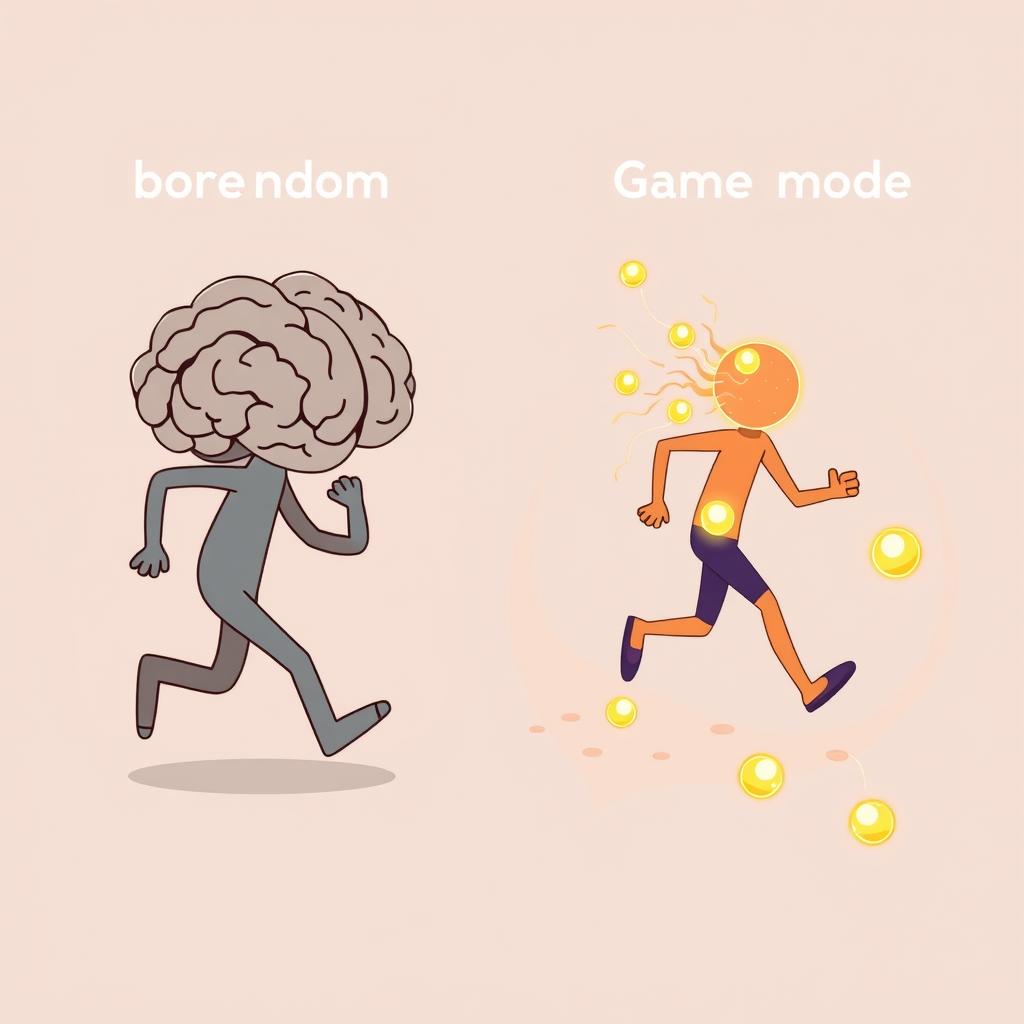
Children do not need to be motivated to run. They run because something interesting is over there. The moment you stop running toward something and start running to execute a metric, you are asking your brain to override its natural reward systems and replace them with abstract future benefits. For people with strong intrinsic motivation toward fitness, that works. For the 2030 demographic who are trying to build the habit from scratch, it is an enormous ask.
This is why gamification, when done with actual creative thought rather than just slapping a badge on a completed run, can genuinely outperform algorithm-driven personalization for habit formation. Not the shallow gamification of a weekly streak counter, but gamification that creates genuine moment-to-moment uncertainty and anticipation.
An app like Geowill takes an interesting approach here — it places collectible treasures on a real map of your neighborhood that only appear during active windows like after work or in the morning, requiring you to actually run to their GPS location to claim them. The treasure grades from common to legendary, and you never know exactly what will appear or where. That unpredictable reward structure is not just fun design. It is operant conditioning, the same psychological mechanism that makes certain games compulsive. Applied to physical movement, it creates a reason to run that has nothing to do with hitting a pace target and everything to do with genuine curiosity about what is out there tonight.
What Human Creativity Actually Looks Like in Fitness Design 💡
The apps that have cracked long-term engagement — and there are a few genuine examples worth studying — share a characteristic that has nothing to do with their AI sophistication. They create situations where a human being feels something. Not data. Feeling.
Parkrun is the obvious non-app example. No AI. No personalization engine. A free weekly 5K, same time, same place, run by volunteers, with a barcode system for timing. Millions of participants globally, with retention rates that embarrass most commercial fitness apps. Why does it work? Because you know the people. Because the same volunteer cheers for you every week. Because finishing feels like something in front of an actual crowd, even a small one.
The apps that come closest to replicating this in digital form do several specific things. First, they create shared context — not global leaderboards but neighborhood ones, where the rankings mean something because you recognize the names. Second, they create real stakes — either social stakes where people who know you can see whether you showed up, or financial stakes through commitment mechanisms. Third, they create narrative — a reason for the run that exists beyond the metrics, whether that is a treasure to find, a club challenge to complete, or a rival from three blocks away who just jumped ahead of you in XP.
The AI in most fitness apps is being used to optimize the wrong variable. It is optimizing training quality for an audience that has not yet decided they want to train at all.
So What Should You Actually Do? 🏃
If you are trying to build a running habit and every AI-driven app has quietly ended up deleted from your phone, here is the honest framework based on what the behavioral research actually supports.
First, add a real financial stake. Write it on paper, or use a commitment platform, or find an app that has a built-in deposit mechanism. Even a small amount — 10,000 won, ten dollars, whatever stings slightly — changes your relationship to skipping a session in a way no streak counter can replicate.
Second, shrink the geography of your social comparison. Find one person, just one, who runs in your neighborhood and is about 20 percent better than you. Follow their activity. Let that be your benchmark, not a global leaderboard.
Third, give your runs a destination that is not a metric. Run to a specific coffee shop and back. Run to a park you have never been to. If you want the full gamified experience, look for apps that put actual collectible objectives on a map of your real neighborhood — that structure of running toward something instead of running to complete something is psychologically very different and dramatically more sustainable for beginners.
Fourth, reduce the optimization. A perfectly calibrated interval session is useless if you do not go. A sloppy 20-minute jog that you actually did is a brick in a real habit. Forgive yourself the optimization and just go somewhere.
The AI in your fitness app is not the enemy. It is a tool being used at the wrong stage of the motivation journey. Until you have already decided you want to run — like, really decided, in your gut, not just in your goal-setting session — what you need is not a smarter algorithm. You need stakes, novelty, proximity to other real humans, and a reason to care right now, tonight, when the couch is right there.
Get that right first. Let the algorithm fine-tune your training block later.