doimoigroup

[태그:] gamification fitness

  • Why Your New Year’s Running Resolution Fails (And How to Fix It)

    It is January 4th. Your new running shoes are still in the box because the weather is too cold, your bed is too warm, and honestly you can convince yourself you will start tomorrow. By January 20th the shoes are under the bed. By February the resolution is a private joke you make with yourself every time you open the fitness app you downloaded and never used. Sound familiar? You are not lazy. You are not weak-willed. You are just fighting the wrong battle using the wrong tools.

    Let us talk about what is actually going on in your brain, why the standard advice fails, and what approaches are genuinely backed by evidence and real-world results.

    Why “Just Build the Habit” Is Incomplete Advice 🧠

    You have heard it a hundred times. Start small. Run five minutes a day. Stack it onto an existing habit. Make it easy. And yes, there is solid research behind habit formation, specifically BJ Fogg’s work on tiny behaviors and James Clear’s popularization of identity-based habits. The advice is not wrong. But it is incomplete, because it treats motivation as a side issue when motivation is actually the main event in the first three months.

    Here is the problem. A habit, by definition, is a behavior that has become automatic through repetition. Getting to automatic takes consistent repetition, which requires consistent motivation before the habit is established. Telling someone to just build the habit skips the 60 to 90 days where motivation has to actively carry the load. Research published in the European Journal of Social Psychology found it takes an average of 66 days for a behavior to become truly automatic, and for more complex behaviors like running it can stretch closer to 90 days. That is a long time to rely purely on willpower.

    The practical gap is this: you need a bridge strategy for those 60 to 90 days, something that generates reliable motivation on days when running feels optional. Most resolution advice never gives you that bridge.

    The Specific Moment Resolutions Die 💀

    If you look at fitness app engagement data, January downloads spike around the 1st, then usage drops sharply around the 12th to 14th. Google Trends searches for “how to start running” peak in the first week of January and fall back to baseline by the second week of February. This is so consistent it has its own nickname: Quitter’s Day, which falls on the second Friday of January according to data analyzed by Strava across millions of users.

    The drop-off is not random. It maps almost exactly onto the first week that running stops feeling new and exciting and starts feeling like work. The novelty effect, which is a measurable neurochemical response your brain has to new stimuli, wears off in roughly 7 to 14 days. After that, the dopamine you were getting just from the freshness of the activity disappears, and you are left with the raw difficulty of running without the neurochemical reward.

    This is why people say things like “I was so motivated at first, I do not know what happened.” Nothing went wrong with your character. Your brain just processed the activity as no longer novel. Without a replacement reward structure, the behavior feels unrewarded and fades.

    What Gamification Actually Does to Your Brain 🎮

    Gamification gets dismissed as gimmicky, but that misunderstands the mechanism. The point is not to trick yourself into running by pretending it is a video game. The point is to engineer consistent, variable rewards into an activity that would otherwise only deliver rewards infrequently and unpredictably.

    Variable reward schedules, made famous by B.F. Skinner and later applied extensively in game design, are neurologically more compelling than fixed reward schedules. A slot machine pays out on a variable schedule and that is precisely why it is more engaging than a vending machine that reliably gives you a snack. When you do not know exactly when the next reward is coming, your brain stays more alert and engaged.

    Applied to running, this means replacing “I ran 3km and now I feel mildly okay about myself” with a structure that delivers unpredictable, layered rewards. XP points that unlock new levels. Rare collectibles that appear at random locations. Streaks with escalating stakes. These are not distractions from the fitness goal. They are scaffolding that keeps you showing up long enough for the actual fitness benefits and genuine habit formation to kick in.

    The research supports this. A 2019 study in JMIR Serious Games found that gamified fitness apps increased physical activity levels by an average of 27 percent compared to standard tracking apps over a 12-week period. That 12-week window is almost exactly the gap where motivation needs to carry the load before habit automation takes over.

    Some apps have taken this seriously. Geowill, for example, built its entire design around location-based treasure hunts where rare and legendary collectibles appear randomly on a map near you, and you have to physically run to them to collect them. The variable reward is baked directly into the GPS movement, so the run itself becomes the mechanism of discovery rather than just the price you pay for the reward.

    Why Accountability Alone Is Not Enough (But Community Is) 🤝

    There is a popular piece of advice that says “tell people about your goal” or “get an accountability partner.” The intention is good but the execution often backfires. Research by Peter Gollwitzer at NYU found that when people announce goals publicly, their brains sometimes register the social recognition of the announcement itself as partial goal achievement, which actually reduces motivation to follow through. Telling the world you are going to run a 5K can feel almost as good as running it.

    What works differently, and better, is embedded community rather than announced accountability. The distinction matters. Announced accountability is: “I told my friends I will run three times this week, so now I feel watched.” Embedded community is: “There are people in my neighborhood running right now, and I am either part of that or I am not.”

    The psychological mechanism here is belonging and social identity rather than external pressure. When you identify as a runner in a specific community, skipping a run costs you something that matters to you: your place in that social group. This is far more durable than the temporary discomfort of letting down an accountability partner.

    Neighborhood-based running communities leverage this especially well because proximity adds stakes. It is one thing to disappear from an online fitness forum. It is another to see the runners you know from your block showing up on a real-time map in your area while you are sitting on your couch. Local social context makes abstract social comparison concrete and immediate.

    The Financial Stakes Method: Why Putting Money On It Works 💰

    One of the most underused motivation tools is commitment devices with real financial consequences. This is not a gimmick. It is behavioral economics applied directly to your own brain.

    Richard Thaler and Shlomo Benartzi’s research on loss aversion shows that people feel the pain of losing something roughly twice as intensely as they feel the pleasure of gaining something equivalent. Losing 10,000 won feels about twice as bad as winning 10,000 won feels good. This asymmetry, known as loss aversion, is hardwired into human psychology and you can deliberately use it to your advantage.

    The structure that works is simple: you commit a specific amount of money against a specific, measurable goal with a specific deadline. Not “I will run more,” but “I will run 20km total within the next 30 days, and I am putting 10,000 won on it.” If you succeed, you get the money back. If you fail, you lose it.

    The research on commitment contracts like this is genuinely impressive. A study published in Preventive Medicine Reports found that financial commitment contracts increased the probability of meeting exercise goals by 47 percent. The key is that the stakes have to feel real. A token amount you would not notice losing does not trigger sufficient loss aversion. The number needs to sting a little.

    Apps like Geowill have formalized this into what they call a “burn your bridges” mission, where your deposit goes into a pool that gets redistributed to successful participants if you fail. That structure adds a second layer: your failure literally funds someone else’s reward, which intensifies the loss aversion response significantly.

    If you want to try this without any app, you can do it manually. Write down your goal, deposit cash with a friend, and agree in writing what constitutes success or failure. The psychological effect of a physical commitment, even on paper, measurably increases follow-through rates.

    Building Your Own Anti-Quit System in January 🛠️

    Based on everything above, here is a concrete framework you can apply starting today.

    First, accept that the first two weeks will feel good on their own. Do not mistake early enthusiasm for a habit. Use those two weeks to establish your reward structures before the novelty wears off, not after.

    Second, choose one gamified element and one financial element. The gamified element should deliver variable rewards: a running app with challenges, collectibles, or streak bonuses, or simply a personal point system you maintain in a notes app where you award yourself points for different run distances and conditions. The financial element should follow the commitment contract model described above, with a real number that stings.

    Third, find one local runner or running group before week two ends. Not a global forum. Ideally someone in your neighborhood or same city district. The local social proximity effect only activates when you feel the community is physically nearby and observable.

    Fourth, define failure specifically. “I will run three times a week” fails because it has no endpoint and no stakes. “I will run a total of 30km in January and I owe my friend 15,000 won if I do not have a screenshot of my GPS logs to prove it by January 31st” is a commitment contract.

    Fifth, plan for the 14-day slump explicitly. Put a reminder in your calendar for January 15th that says: the novelty is gone and this is where most people quit. Have your backup motivation ready: your financial stake, your local running notification, your streak counter. Knowing the slump is coming does not eliminate it, but it removes the psychological surprise that makes people interpret the motivational dip as personal failure.

    Closing Thoughts 🌅

    The reason your running resolution fails is not a character flaw. It is a design flaw. You are using a motivation structure, pure willpower and vague intention, that was never built to survive beyond two weeks against a behavior that takes two to three months to become automatic.

    The fix is engineering: variable rewards that keep your brain engaged, financial stakes that activate loss aversion, and local community that ties your identity to the behavior before the habit is solid enough to stand on its own. These are not hacks. They are how human motivation actually works, applied intentionally.

    This January, do not just set a resolution. Build the scaffolding. The run will follow.

  • Why Gamification Is the Secret Weapon Against Runner’s Burnout

    You told yourself this time would be different. You downloaded a running app, bought decent shoes, and even set a 6 AM alarm. The first week felt genuinely great. By week three, you were bargaining with yourself on the couch — “I’ll go tomorrow, it’s basically the same.” By week five, the app had sent you four guilt-trip notifications you swiped away without reading. Sound familiar? That cycle has a name: runner’s burnout. And it hits hardest not after marathons, but in the ordinary middle of a routine that stopped feeling like anything at all.

    The frustrating truth is that most people do not quit running because it is too hard physically. They quit because it stopped being interesting. The body adapts, the novelty evaporates, and suddenly every run is just… a run. Same streets, same playlist, same number on the screen. The solution is not more willpower. The science actually points somewhere more counterintuitive — toward play.

    🔥 Why Your Brain Treats “Just a Run” Like a Chore

    When you first start running, your brain fires dopamine like a pinball machine. New movement, new sensory input, visible progress week over week. Neuroscientists call this the novelty-reward response, and it is genuinely powerful. The problem is that it is also temporary. After roughly six to eight weeks of consistent running, your brain has catalogued the activity as familiar, the reward signal drops, and motivation starts depending entirely on discipline instead of desire.

    Discipline is finite. It is the same mental resource you use to answer emails, avoid the office candy bowl, and not say what you actually think in that meeting. By the time 7 PM rolls around, there is often not much left. This is why so many runners hit a wall not in their legs but in their heads around the six-week mark.

    What gamification does, at its core, is hack the novelty-reward loop back open. It introduces variable rewards — outcomes you cannot fully predict — which are the single most effective driver of sustained engagement that behavioral psychology has identified. Slot machines use this principle. So does every RPG you have ever lost a weekend to. The key insight is that variable rewards work not because they trick you, but because they keep your brain genuinely uncertain about what comes next, and uncertainty is attention.

    🗺️ What Geo-Treasure Hunting Actually Does to a Run

    Here is the concrete shift that geo-treasure hunting creates: it transforms a destination-less loop into a scavenger hunt. Instead of running three kilometers for the abstract goal of “health,” you are running 800 meters to a specific park bench because there is a rare item there, and it will not be there tomorrow.

    That distinction matters more than it sounds. Goal specificity is one of the most replicated findings in motivation research. Edwin Locke’s goal-setting theory, developed across decades of studies, consistently shows that specific, proximate goals outperform vague long-term ones by a significant margin in producing sustained effort. “Run more this month” is a losing goal structure. “Reach that location before someone else does” is a winning one.

    Geo-based running mechanics also solve a subtle but critical problem: route boredom. When the treasure spawns in a direction you never go, you explore parts of your own neighborhood you have walked past a hundred times without actually seeing. That spatial novelty alone reignites the brain’s exploration circuits. Research from the University of Exeter found that running in new environments produces meaningfully higher post-run mood scores than the same distance covered on a familiar route. New sights are not just nice — they are functionally motivating.

    Apps like Geowill have built this mechanic out into a full system, with treasure rarity tiers that unlock at higher levels, meaning the incentive structure deepens over time rather than flattening out. That tiered reward design directly addresses the six-week novelty cliff.

    💸 The Psychology of Putting Real Money on the Table

    There is a specific mechanic that deserves its own section because it is the most psychologically potent tool in the gamification toolkit: commitment contracts with financial stakes.

    Behavioral economists call the underlying principle loss aversion. Daniel Kahneman’s research established that losing something feels roughly twice as painful as gaining the equivalent thing feels good. In practical terms, this means the threat of losing twenty dollars motivates most people more than the promise of gaining twenty dollars — even when the rational math is identical.

    Commitment contracts weaponize this asymmetry for your benefit. You set a running goal, deposit a real amount of money, and if you hit the goal it comes back to you. If you do not, it is gone. Studies on platforms like stickK, which was built on Kahneman’s research with Yale economists, show completion rates for exercise goals jump by 30 to 40 percent when financial stakes are present versus when goals are logged with no consequence.

    The design detail that makes this even more interesting is what happens to the lost money. When it goes to a cause you dislike, completion rates go even higher than when it goes to charity. The emotional driver is not generosity — it is the visceral discomfort of imagining that specific loss. Some running gamification systems now distribute failed deposits as a reward pool to everyone who succeeded, which creates a fascinating dual motivation: you are simultaneously avoiding a loss and competing for a small gain funded by the people who gave up.

    This is not gimmicky. It is applied behavioral science, and for people who genuinely struggle to self-motivate, it can be the difference between a habit that sticks and one that does not.

    🏘️ Why Your Neighborhood Runners Are More Motivating Than Any Influencer

    Fitness influencers are aspirational but abstract. Seeing someone with a perfect physique run a sub-four-minute kilometer does not make most people want to run — it makes them feel like running is for a different kind of person.

    What actually works, according to a 2016 study published in Nature Communications, is seeing people similar to you exerting effort and achieving something. Social comparison with near-peers — people slightly ahead of you in fitness level or achievement — produces the strongest motivational pull. Not professionals. Not beginners. People who look like a version of you that ran a little more this week.

    Neighborhood-based running communities exploit this beautifully. Knowing that three people within two kilometers of you just logged runs in the last hour, seeing their real-time positions on a shared map, watching someone one level above you collect a rare item in the park you pass every day — that is the kind of social signal that actually moves you off the couch. It is specific, it is local, and it is happening right now.

    This is categorically different from global leaderboards, which almost always demotivate average users because the gap is too large to feel closeable. Hyperlocal community design — by neighborhood, by district — creates a competitive radius that feels winnable. That psychological accessibility is what makes people try.

    🎮 Building a Sustainable Running Habit Through Game Mechanics: A Practical Framework

    Even if you never use a single app, the principles behind running gamification can reshape how you structure your own training. Here is a concrete framework drawn from the underlying behavioral science.

    First, install a variable reward into every run. This does not require technology. Before you head out, write three possible routes on slips of paper and draw one randomly. The uncertainty itself creates a small but real engagement boost. If you want to go further, use a free geocaching app to plan a run that passes two or three real-world cache locations. The hunt does the motivational work the destination would not.

    Second, create a proximate goal for every single session rather than only tracking monthly mileage. Monthly targets are too distant to feel real. “Reach the fountain at the north end of the park” is a session goal your brain can grip. Stack five of those and you have covered a solid distance without ever staring at a kilometer counter.

    Third, add a commitment layer with actual stakes. This can be as simple as a verbal bet with a friend, a shared spreadsheet that others can see, or a small financial wager with a training partner. The key is that the consequence is real, specific, and uncomfortable enough to matter. A ten-dollar dinner bill you pay if you miss a week’s runs is often more motivating than a hundred-dollar gym membership that auto-renews invisibly.

    Fourth, track XP instead of — or in addition to — calories or distance. Experience points feel like accumulation even when a run was slow or short. A bad run that still earns 50 XP feels like progress. A bad run logged as “2.1 km, 13 min/km” feels like failure. The framing changes what your brain does with the data.

    Fifth, join or create a local group rather than a global one. A WhatsApp group of eight runners in your neighborhood will outperform a massive online community almost every time, precisely because the social comparison distance is calibrated to feel achievable.

    ✅ The Real Reason Every Mile Starts to Matter Again

    Runner’s burnout is not a character flaw. It is a predictable neurological event that happens when a repetitive behavior loses its signal value to the brain. Understanding that reframes the entire problem. You do not need more grit. You need better game design.

    Geo-treasure hunting works because it re-attaches meaning to individual miles — not abstract health meaning, but immediate, specific, “this particular kilometer leads to something” meaning. Financial commitment contracts work because they make quitting genuinely costly in a way your brain cannot rationalize away. Local social mechanics work because they put the right kind of competition in front of you: winnable, visible, and personal.

    The runners who sustain the habit long-term are almost never the ones with the most discipline. They are the ones who built a system interesting enough that discipline was rarely required. Apps like Geowill are compelling examples of this philosophy taken seriously as a design principle — every feature oriented around the question of how to make the next run feel like it actually matters right now.

    But even with no app at all, the framework is yours to use. Make the goal specific. Make the route uncertain. Make the stakes real. Make the community local. Do those four things and the question stops being “how do I make myself run today” and starts being “which direction does the treasure spawn tonight.” That is not a small shift. That is the whole game.

  • Why Gamifying Your Running Routine Kills Motivation Loss for Good

    You downloaded a running app on a Sunday night, set your alarm for 6 AM, laid your shoes by the door, and went to bed actually excited. By Thursday, the alarm got snoozed. By the following Monday, the app was buried three screens deep. Sound familiar? You are not lazy. You are just experiencing one of the most well-documented psychological phenomena in behavior science: the motivation cliff. And the reason most running routines fall off it has almost nothing to do with physical fitness.

    Here is the real problem: running, as it is traditionally framed, offers almost no feedback loop in the short term. You run. You are tired. You do it again tomorrow. The reward — a leaner body, better endurance, a longer life — is so far in the future that your brain, which is wired for immediate gratification, simply stops caring. This is where gamification enters, and it is not just a trendy word. It is a structural fix for a very specific psychological problem.

    The Motivation Cliff Is a Design Flaw, Not a Character Flaw 🧠

    Motivation researchers distinguish between two types: intrinsic motivation, which comes from within, and extrinsic motivation, which comes from outside rewards. The conventional fitness industry bets everything on intrinsic motivation — “find your why,” “love the process,” “run for yourself.” That advice is not wrong, but it skips a critical phase.

    The problem is that intrinsic motivation for running typically develops after about six to eight weeks of consistent practice, once the physical experience of running actually starts to feel less awful. But most people quit in weeks two or three. That gap — the period between starting and actually enjoying it — is the motivation cliff, and it is where virtually everyone falls.

    Psychologist B.F. Skinner’s operant conditioning research from the 1950s showed something that still holds up perfectly: variable reward schedules produce the most persistent behavior. This is why slot machines are addictive and why checking your phone is compulsive. Your brain releases dopamine not just when you get a reward, but in anticipation of a reward that might arrive. Fixed schedules — run five kilometers, feel good, repeat — are actually among the weakest behavior drivers. Unpredictability is far more powerful.

    Gamification exploits exactly this. When your run might reveal a rare reward, unlock a new level, or shift your position on a live leaderboard, the anticipation itself becomes a motivational engine that bridges the gap until intrinsic love for running has time to develop.

    What Gamification Actually Does to Your Brain Mid-Run 🎮

    People often assume gamification just means adding points to something. That is the surface version. The deeper mechanism operates across several neurological channels simultaneously.

    First, there is the progress principle, identified by Harvard researcher Teresa Amabile. Her studies found that the single biggest day-to-day motivator for human beings is the feeling of making progress on meaningful work. In running, progress is invisible on a Tuesday morning when you are still slow and still out of breath. Gamification makes progress tangible and immediate — you gained XP, you moved up three spots on the neighborhood leaderboard, you unlocked a new badge. Your brain registers forward movement even when your lungs disagree.

    Second, gamified running systems introduce what behavioral economists call commitment devices. A commitment device is any structure you set up in advance that makes a future behavior harder to abandon. Odysseus tying himself to the mast is the classic example. In fitness, putting money on the line is one of the most effective commitment devices studied. A 2016 study published in the Journal of Health Psychology found that financial incentives with a loss-framing — meaning you stand to lose money rather than gain it — increased exercise adherence by up to 45 percent compared to control groups. Losing twenty dollars feels roughly twice as painful as gaining twenty dollars feels good. Smart fitness systems use that asymmetry to keep you moving.

    Third, social visibility changes behavior in ways that purely solo tracking cannot. Knowing that people in your actual neighborhood can see your run in real time creates what psychologists call social accountability. This is different from posting a run on Instagram after the fact. Real-time visibility shifts the cost of quitting from abstract to immediate.

    The Treasure Hunt Frame: Why Location-Based Running Works 🗺️

    One specific gamification approach worth understanding in detail is location-based running — where the geography of your actual neighborhood becomes the game board. It sounds simple, but the psychological effect is significant.

    Traditional treadmill or track running asks you to run in place or in circles. The environment never changes, which means the only variable is your suffering level. Urban running on familiar streets is marginally better, but most runners default to the same two or three routes, and familiarity breeds boredom faster than you think.

    Location-based running replaces route familiarity with destination pull. Instead of deciding to run for thirty minutes (a time-based goal that your brain experiences as endurance against discomfort), you have a specific place to go — and something waiting for you when you get there. This reframes the entire cognitive experience. You are not grinding through kilometers. You are going somewhere.

    This matters more than it sounds. Goal-setting research consistently shows that approach goals (moving toward a specific target) generate more sustained motivation than avoidance goals (running away from health problems) or duration goals (running for X minutes). Having a destination — even a virtual one — structurally changes your relationship to the effort.

    Geowill, a Korean-built running app, uses exactly this mechanic: treasure chests appear on a live map of your neighborhood during peak activity windows, and you have to physically run there and check in within one hundred meters to collect them. The chests come in different rarity tiers, so you never know in advance if the one three blocks away is common or legendary. That uncertainty is not accidental. It is the variable reward schedule in action.

    Building the Gamified Running Habit That Actually Sticks 📅

    Understanding the psychology is only useful if you can translate it into a practice. Here is a concrete approach to building a gamified running habit from zero, regardless of what tools you use.

    Week one and two: prioritize reward density over distance. Your only job in the first two weeks is to run often enough that the habit anchor forms. Research by Phillippa Lally at University College London found that habit formation takes between 18 and 254 days, with a median around 66 days, but the critical window is the first three weeks where the behavior needs to become contextually automatic. Keep runs short — even fifteen minutes — but load them with feedback. Check your live pace. Log your XP. Track your map coverage. Use every small number going up as proof of progress.

    Week three and four: introduce a commitment device. This is the moment to raise the stakes slightly. You can use financial commitment platforms, a running bet with a friend, or apps that hold a deposit against a goal. The key is that the penalty for quitting has to feel genuinely uncomfortable. A five-dollar bet with someone who will forget about it provides almost no behavioral leverage. A twenty-dollar deposit you actually care about losing is a different story.

    Week five onward: layer in social accountability. Join or create a neighborhood running group, follow local runners on whatever platform you use, and make your activity visible to people who are geographically close to you. Proximity matters because neighborhood-based accountability feels more real than anonymous online communities. When the person on the leaderboard above you lives two streets away, the gap between you is not an abstraction.

    One practical note: avoid gamification overload. Using six different apps simultaneously, tracking every possible metric, and participating in multiple challenges at once creates decision fatigue that ironically kills motivation. Pick one primary gamification layer and one social layer. Add complexity only after the base habit is solid.

    Why Social Proof From Your Neighborhood Hits Different 🏘️

    There is a well-known psychological phenomenon called the spotlight effect — the tendency to overestimate how much others notice and judge our behavior. In most social contexts, this creates anxiety. In fitness gamification, it can be strategically flipped.

    Seeing a runner you recognize from the leaderboard actually on the street near your house creates a specific kind of motivation that global fitness communities cannot replicate. It converts running from a solo internal struggle into a shared local activity. Researchers studying urban social cohesion have found that neighborhood-based shared physical activity is one of the fastest ways to build genuine community bonds — faster than shared workplaces, faster than shared online spaces.

    This is also why city-wide running groups that meet at specific public locations have survived for decades without apps or gamification. The neighborhood frame does something powerful: it makes your effort legible to people who share your context. They know how hilly that street is. They know how bad the wind gets near the river. That shared context creates a specific kind of respect that global fitness communities, where everyone is anonymous and everywhere, simply cannot generate.

    The practical takeaway is to actively choose running tools that emphasize local visibility over global metrics. Your rank among the ten people who run in your neighborhood is a far more motivating number than your rank among ten million app users worldwide.

    Closing: The Real Secret Is Closing the Motivation Gap 🏁

    Here is the honest version of what gamification does and does not do. It does not make running easy. It does not eliminate the discomfort of the first kilometer. It does not replace the genuine satisfaction that comes from building real fitness over months. What it does is buy you the time you need to reach that satisfaction — by making the short-term experience rich enough that your brain does not quit before the long-term rewards have a chance to arrive.

    The motivation cliff is real, it is predictable, and it is beatable. You beat it not through discipline or willpower alone, but by redesigning the feedback environment so that progress is visible, rewards are variable and immediate, stakes are real, and other people are watching. Those four elements together are what gamification, done well, actually provides.

    If you are looking for a running tool built specifically around this model — the treasure hunt mechanic, the financial commitment layer, and neighborhood-based social accountability all in one place — Geowill is worth exploring, particularly if you are in Korea or want an experience designed from the ground up for exactly that gap between wanting to run and actually running.

    But even if you never touch an app, you can build these principles into your own system starting today. Find a destination, make a bet, find a local runner to chase. The shoes by the door are not enough. The game has to be worth playing.

  • Why Gamification Is the Secret Weapon Against Running Motivation Slumps

    You downloaded a running app on a Sunday night, feeling genuinely inspired. You set a goal, picked a playlist, and went to bed excited. Monday’s run happened. Tuesday’s run happened. By Thursday you were bargaining with yourself, and by the following Wednesday the app had sent you three sad little notification badges that you immediately dismissed. Sound familiar? You are not lazy. You are not lacking discipline. You are just human, and humans are spectacularly bad at sustaining motivation for activities whose rewards live entirely in the abstract future.

    This is where gamification enters the conversation, and not in the shallow “badges are fun” way that fitness brands love to throw around. Real gamification, applied thoughtfully to something like running, rewires the reward loop at a psychological level. For Gen Z and millennials especially, who grew up inside feedback-rich digital environments, this is not just a nice bonus. It is the difference between a three-day streak and a three-month habit.

    🧠 Why Your Brain Keeps Quitting (And It’s Not a Willpower Problem)

    The human brain is an optimization machine, and it is ruthlessly logical about effort versus reward. Running, especially when you are just starting out, is physically uncomfortable, socially invisible, and staggeringly slow to produce results you can actually see or feel. The dopamine hit you get from finishing a run is modest and delayed. Compare that to literally anything else on your phone, where the reward cycle is measured in milliseconds, and you start to understand why going for a run loses the internal competition almost every time.

    Neuroscience research from the University of Michigan shows that dopamine is released not just at the moment of reward, but in anticipation of it. This is why you feel a little buzz just opening a game you enjoy, before anything has even happened. Traditional running offers almost none of this anticipatory excitement, particularly in the early weeks when every run feels like a negotiation with your own lungs. The motivation slump that hits around day eight to fourteen of a new running routine is not a personal failing. It is your brain accurately calculating that the effort-to-reward ratio does not make sense yet, and lobbying hard to reallocate your energy toward something more immediately satisfying.

    Gamification intervenes at exactly this calculation. When your run has a concrete, time-sensitive objective attached to it, your brain can run its anticipation circuitry on something it can actually get excited about. The run stops being a formless commitment to your future health and becomes a specific mission with a specific payoff at the end.

    🎮 What Real Gamification Does (Vs. the Badge-and-Streak Watered-Down Version)

    Not all gamification is created equal, and it is worth being honest about why so many fitness apps fail at it despite claiming to offer it. Slapping a streak counter on an existing routine is not gamification. It is a thin coat of paint on the same motivation problem. True gamification imports the structural mechanics that make games actually compelling: variable reward schedules, meaningful stakes, social competition, and a clear progression system that makes you demonstrably better over time.

    A young person in casual athletic wear standing at a crossroads in a colorful city neighborhood, looking at their phone with

    Variable rewards are critical. The reason slot machines are so difficult to walk away from is the unpredictability of when the reward arrives. If every run rewarded you with exactly the same outcome, you would habituate to it quickly. But if some runs yield something rare, something you could not have predicted, your brain stays engaged in a qualitatively different way. This is the psychology behind loot boxes in gaming, and it is why running apps that introduce random, tiered reward elements retain users at significantly higher rates than those with purely linear progress systems.

    Meaningful stakes are the second ingredient most fitness gamification ignores entirely. A virtual badge has no real cost attached to it. You can miss a day, lose the streak, and feel momentarily bad before moving on. But when there is something genuinely at risk, something you care about losing, the psychological calculus shifts dramatically. Behavioral economists call this loss aversion, and it is one of the most consistently replicated findings in the field. Losing something you already possess motivates you roughly twice as powerfully as the prospect of gaining something equivalent. Fitness apps that build actual stakes into their challenge systems, where missing your goal has a tangible, real-world consequence, are tapping into a completely different motivational register than apps that offer only the carrot with none of the stick.

    Social competition, done right, adds a third layer. Not the hollow kind where you compete against strangers on a global leaderboard you have no emotional connection to, but hyperlocal competition with people who run the same streets you do. Knowing that someone in your neighborhood is two hundred XP points ahead of you on a route you both use is a far more compelling motivator than knowing some person in another city logged fifty miles last week.

    🏆 The Specific Mechanics That Actually Work for Gen Z Runners

    Gen Z’s relationship with motivation is genuinely different from previous generations, and not in the deficient way older commentators often frame it. Gen Z grew up in environments where feedback loops were tight, progress was visible, and achievement was multi-dimensional. The idea of working hard for six months before seeing any meaningful signal of progress is not demotivating because Gen Z is impatient. It is demotivating because they have a calibrated sense for what good feedback systems look like, and traditional running provides a genuinely poor one.

    The mechanics that land best with this demographic tend to share a few characteristics. First, spatial novelty. Running the same loop becomes mentally stultifying fast. Any system that makes the geography of a run feel alive and unpredictable, whether through route challenges, location-based objectives, or neighborhood exploration prompts, dramatically extends the novelty ceiling. Apps like Geowill, which summon treasure objectives to specific real-world locations that you have to physically run to and check in at within 100 meters, are tapping into this directly. The city itself becomes the game board, and every run could reveal something new in a neighborhood you thought you already knew.

    Second, tiered progression that actually unlocks things. Leveling up should mean something changes, not just that a number increases. The difference between a common reward and a rare or legendary one should feel meaningful, and the probability of hitting the higher tiers should be low enough to feel genuinely exciting when it happens. Running apps that offer only cosmetic progression quickly lose the attention of users who have been conditioned by actual games to expect meaningful mechanical unlocks.

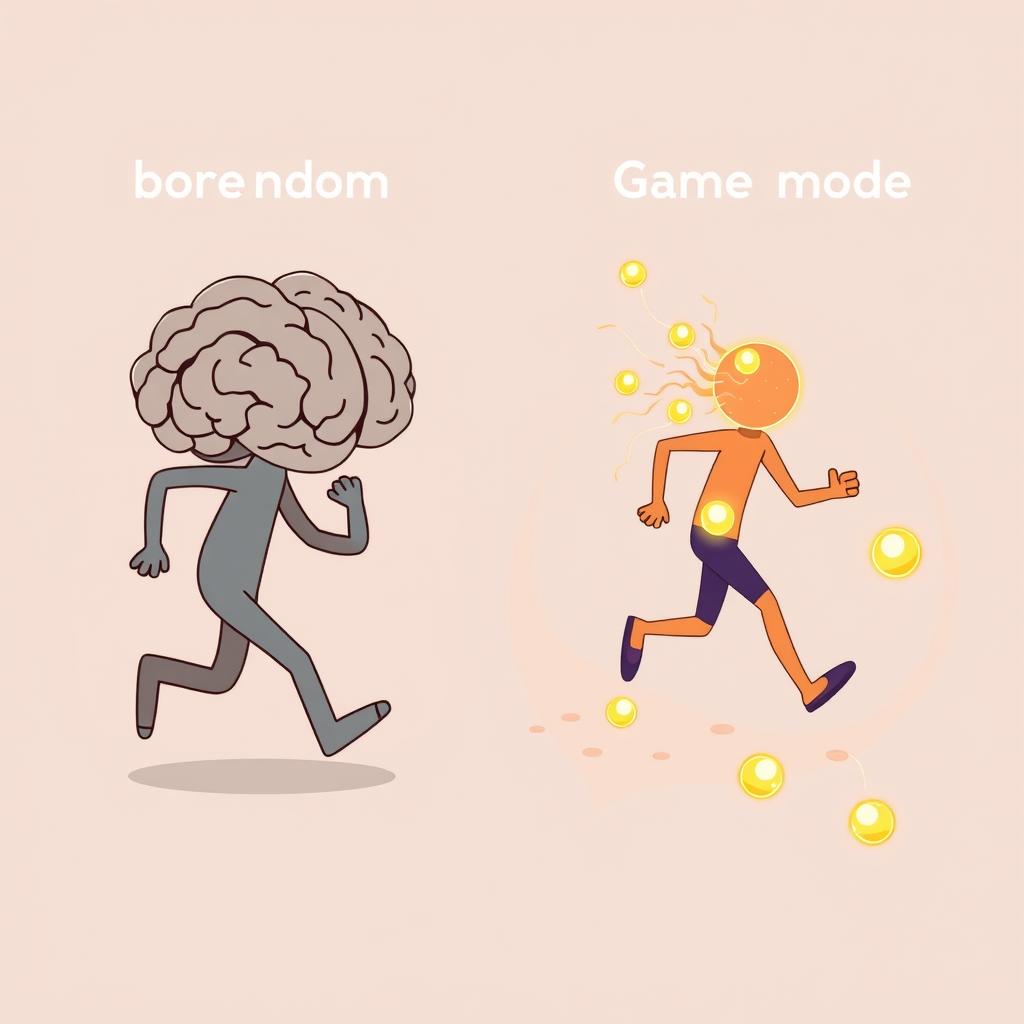
    A split illustration showing two brain states side by side, one labeled boredom with a gray running figure, one labeled game

    Third, and this is one that gets underestimated: time pressure with real consequences. The commitment device is one of the most powerful behavioral tools in existence. Behavioral economist Richard Thaler’s work on commitment contracts shows that when people put something at stake themselves, voluntarily, the follow-through rate jumps substantially compared to willpower-only approaches. A mission structure where you deposit real money, define a real distance goal, and either get it back plus a share of other people’s forfeited deposits, or lose it entirely, is not just motivating. It is psychologically sophisticated in a way that aligns with how Gen Z already thinks about accountability.

    💬 The Social Layer Nobody Talks About Enough

    Running has always had a social dimension, but it has historically been inaccessible to beginners. Local running clubs tend to attract people who are already serious runners, which creates an implicit intimidation barrier for anyone still figuring out a comfortable pace. The 5K feels embarrassing when everyone else is warming up for their marathon training run.

    Hyperlocal, app-mediated social layers solve this by creating communities organized around geography and shared starting points rather than performance level. When the leaderboard is your neighborhood and includes people who started the same week as you, competition becomes encouraging rather than humiliating. Real-time visibility of other runners in your area, even just seeing that someone a block away is currently on a run, creates a subtle but genuinely powerful sense of ambient social accountability.

    The social feed and club mechanics that good running gamification apps include are not frivolous. Research on exercise adherence consistently shows that social obligation is one of the most powerful predictors of sustained workout behavior. Telling people you run is surprisingly effective. Having those people watch you run, even passively through an app, is more effective still.

    📈 Building a Habit That Outlasts the Novelty Phase

    Here is the part that gamification skeptics get right: novelty fades. The treasure hunt that felt exciting in week one will feel routine by week eight unless the system is well-designed enough to keep evolving. This is why the best gamified fitness approaches use gamification as a scaffold rather than the structure itself.

    A diverse group of young urban runners celebrating together on a city street at golden hour, phones in hand, expressions of g

    The goal is not to run forever because a game told you to. The goal is to use the game’s reward loops to carry you through the first twelve weeks, which is roughly the window behavioral research suggests is needed to solidify an aerobic habit at a neurological level. By the time the gamification loses some of its novelty, you should have physiological and social hooks that sustain the behavior on their own. You feel genuinely better when you run. You have a group of people who expect to see you. You have a pace that feels comfortable rather than punishing. The game built the bridge; you are now on the other side.

    Practically, this means treating gamified running apps as a deliberate on-ramp. Use the missions, the stakes, the leaderboards with full commitment for the first three months. Set the hardest commitment challenge you believe you can realistically complete, not the safest one. Check the leaderboard more than feels cool to admit. Follow the local runners and actually cheer for them. Let yourself be a little too invested in finding the rare reward. That investment is doing real neuroscientific work on your behalf.

    🏁 The Takeaway: Stop Trying to Out-Discipline Your Own Brain

    Motivation slumps are not character flaws. They are predictable outputs of a brain that evolved to conserve energy and seek immediate rewards, trying to function inside a fitness routine that offers neither. The runners who make it to month four are not more disciplined than the ones who quit in week two. They have usually just found a structure that makes the effort feel worth it before the long-term benefits kick in.

    Gamification, done with genuine mechanical depth, is not a gimmick. It is an evidence-aligned way of making your brain’s reward system work with your fitness goals rather than against them. For Gen Z runners especially, who have a finely tuned detector for whether a feedback system is actually good, the quality of the gamification matters enormously. A streak counter will not cut it. What works is spatial novelty, real stakes, hyperlocal social competition, and a progression system that keeps unlocking something worth chasing.

    If you are in the early weeks of a running habit and the motivation is already wobbling, the honest answer is not to dig deeper into willpower. It is to redesign the game you are playing until winning it genuinely feels worth the run.

  • Why Your Morning Run Needs Gamification (And Real Money Stakes)

    Your alarm goes off at 6:47 AM. You set it with full intention last Sunday night — new week, new you, finally going to build that running habit. You pick up your phone, open your running app, stare at the blank start screen, and then spend the next eleven minutes scrolling through nothing in particular until it feels too late to bother. Sound familiar? You are not lazy. You are just not getting the right kind of push.

    Here is the thing most fitness advice gets wrong: motivation is not a personality trait. It is a design problem. And the solution is not willpower — it is understanding what your brain actually responds to and building a system around that.

    Why “Just Run More” Is Terrible Advice 🧠

    The traditional approach to building a running habit is basically this: decide you want to run, feel bad when you do not, try harder tomorrow. It treats motivation like a fuel tank that refills if you just feel guilty enough. Behavioral science disagrees pretty loudly with that model.

    What actually drives repeated behavior is a feedback loop — cue, action, reward. The problem with running is that the real rewards (better health, lower stress, improved sleep) are delayed by weeks or months. Your brain, operating on ancient survival software, does not naturally prioritize rewards that far out. It prioritizes what feels good in the next two minutes. Staying in bed wins that contest almost every time.

    Gamification is not a gimmick layered on top of fitness. It is a direct intervention in the feedback loop. When you earn points, unlock a level, or hit a streak, your brain gets a small but real dopamine hit right then. You are no longer waiting three months for cardiovascular improvement to feel like this was worth it. You feel the reward today, on this run, in this moment.

    Research published in the Journal of Medical Internet Research found that gamified health interventions increased physical activity significantly more than non-gamified ones, particularly in the 18 to 35 age range. The mechanism is not complicated: frequent, immediate rewards build the habit faster than rare, delayed ones.

    The Psychology of Progress Bars and Points 🎮

    Think about why you have ever kept playing a mobile game well past the point of it being actually fun. The answer is almost always visible progress. You could see your character leveling up. You could see the percentage bar filling. You were, objectively, getting somewhere — and your brain desperately wanted to see that bar hit 100.

    Three runners lined up at a race starting line ready to sprint

    Running apps that only show you raw data — pace, distance, calories — are missing this entirely. Those numbers are abstract unless you already care about them deeply. A 5k at 6:45 per kilometer means something to an experienced runner. To someone three weeks into a new habit, it is just numbers on a screen.

    What changes behavior is relative progress. Not how fast you ran, but how much further you got than last time. Not how many calories you burned, but that you just unlocked a new distance badge. XP systems, leaderboards, and tiered rewards translate the abstract into the concrete and the long-term into the immediate.

    There is also a social dimension that matters enormously here. Seeing that someone in your neighborhood ran 8km this morning while you have logged zero does something that a calorie chart simply cannot. It creates what researchers call social proof — evidence that people like you are doing the thing you want to do — combined with a gentle competitive nudge. Neighborhood-based leaderboards are psychologically more potent than global ones, because global rankings feel unreachable. A local leaderboard with people who literally live on your street? That is a completely different emotional calculation.

    Where Treasure Hunts Change the Game Entirely 🗺️

    Point systems and streaks work, but they still share one weakness: you are running the same routes, doing the same loops, racking up the same kind of reward every time. Predictability eventually kills motivation. When you already know exactly what you will get and roughly what the experience will feel like, the anticipation — which is actually the biggest driver of the dopamine response — disappears.

    Location-based running mechanics solve this by making every run genuinely unpredictable. The premise is simple: rewards are hidden in the real world and tied to actual GPS coordinates in your neighborhood. You have to physically go there to collect them. The destination changes. The route changes. The outcome is uncertain. That uncertainty is not a bug — it is the entire point.

    This structure borrows directly from variable reward psychology, the same principle that makes slot machines compelling and mystery boxes impossible to resist. When you know a reward is coming but not exactly when or how good it will be, you pay attention in a completely different way. Applied to running, it transforms a familiar neighborhood into a space full of possibility rather than a boring loop you have memorized.

    An app called Geowill is built entirely around this idea — treasure icons appear on a live map around you at specific times like after work or in the morning, and you have to actually run to within 100 meters of that location to claim them. The treasures come in different grades, from common to legendary, with higher levels unlocking rarer drops. The result is that you stop thinking about the run as exercise and start thinking about it as an expedition. Your neighborhood feels genuinely different.

    The Real Money Factor: Why Skin in the Game Is a Superpower 💸

    A determined runner mid-stride with sweat on their face, dynamic motion

    Here is where we move past gamification into something with sharper teeth. Points and treasure are powerful for building initial engagement. But for long-term commitment — the kind that survives a rainy Wednesday when you really do not want to go — nothing beats a financial commitment device.

    The concept comes from behavioral economics and was formalized by economists Richard Thaler and Shlomo Benartzi in research on retirement savings. The core insight is this: humans are loss-averse in a way that is not rational. We feel the pain of losing money roughly twice as strongly as we feel the pleasure of gaining the same amount. In practical terms, that means putting $20 on the line hurts more than winning $20 feels good.

    A commitment device exploits this asymmetry deliberately. You agree in advance that if you fail to meet a specific, measurable goal, you lose money. Not to an abstract charity you chose for maximum distance from your daily life — but to other people who succeeded at the exact thing you failed to do. That framing matters. Knowing that your failure literally funds someone else’s reward is motivationally brutal in the best possible way.

    Studies from stickK.com, a platform built on this exact mechanism, show that users who put money on the line complete their goals at significantly higher rates than those who use social accountability alone. When researchers controlled for how much money was at stake, even small amounts — $10, $15 — produced measurable behavior change. The amount matters less than the fact that something real is at stake.

    The Geowill version of this is called a Burn-Bridge Mission, which captures the psychological dynamic well. You set a distance goal, put down a deposit, and if you hit the goal within the time window, you get the full amount back. If you miss it, the money goes into a reward pool for runners who succeeded. No charity abstraction. No vague social consequence. Just the concrete knowledge that your failure becomes someone else’s literal gain.

    This is not about punishment for its own sake. It is about bringing a future consequence into the present moment. When you are lying in bed at 7 AM deciding whether to run, your future health is still months away. But your deposit? That loss is happening right now if you do not move.

    Building Your Own Gamified Running System 🛠️

    You do not need to install any specific app to apply these principles. Here is how to build the psychological stack yourself.

    A running coach pointing at a training schedule with a runner listening attentively

    Start with the variable reward layer. Pick five to eight locations within 2km of your home — a specific bench, a mural, a corner store, anything concrete. Write them on slips of paper. Each morning, draw one at random. That is your destination. Your run is not “going out for 30 minutes.” It is “getting to the red mailbox on Yeonnam-dong corner.” This single change makes every run structurally different and gives you a genuine endpoint to reach.

    Add a social visibility layer. Find one other person in your neighborhood — a friend, a neighbor, someone from a local running group — and share your weekly distance total with them every Sunday. The visibility alone creates low-level social pressure that punches above its weight in behavioral terms.

    Then add the money layer. Use a free commitment contract app or simply write a note to someone you respect: if I do not run X kilometers by X date, I owe you Y amount in cash. Make it real enough to sting but not so punishing that you abandon the whole system on day three.

    Finally, track progress visibly. A paper calendar on your wall where you mark each run day works better than a hidden app stat for many people, precisely because it is visible and social. Streaks on paper feel breakable in a way that hurts.

    The Bottom Line 🏁

    The reason most running habits fail is not effort — it is architecture. When the feedback loop between effort and reward is measured in months, your brain will always find a reason to opt out today. Gamification compresses that loop into minutes. Financial commitment devices make the cost of skipping real and immediate. And location-based mechanics make each run feel like something worth actually showing up for.

    You do not need to become a competitive runner or sign up for a half marathon to make this work. You just need to stop treating motivation as something you either have or do not have, and start treating it as a system you design. Put something real on the line. Make the destination surprising. Let other people see you moving.

    The alarm is going to go off again tomorrow morning. The difference is what you have set up in advance that makes getting up the easier choice.

  • Why Your Running Motivation Dies After Week 2 (And How Gamification Fixes It)

    You downloaded the running app on a Monday. You ran Tuesday, Thursday, and even Saturday. You felt genuinely good about yourself. Then week two arrived, it rained on Wednesday, you skipped once, and somehow that one skip became the permanent end of your running career. Sound familiar?

    This is not a willpower problem. This is not a discipline problem. This is a neuroscience problem, and once you understand exactly what is happening inside your brain during those first two weeks, you can actually do something about it.

    🧠 The Week 2 Drop-Off Is Shockingly Predictable

    Research from University College London puts habit formation somewhere between 18 and 254 days, with the average sitting around 66 days. Yet most running apps, coaches, and well-meaning friends act like two weeks of consistency should have you locked in for life. It will not. Two weeks is the exact point where the novelty has worn off but the habit has not yet formed.

    Here is what happens neurologically. When you start running, everything is new. Your brain releases dopamine not because of the run itself, but because of the novelty — the new gear, the new route, the new identity you are building. This is called the exploration phase, and your brain is basically giving you free dopamine samples. By day 10 to 14, novelty fades. The brain has categorized running as a known activity, the free dopamine stops, and now the actual work of habit formation has to begin. If there is no reward structure in place to bridge that gap, your motivation evaporates on schedule.

    This is why so many people describe running as something they “used to do.” The quit always happens in the same window because the brain’s reward system follows a predictable timeline, not a character flaw timeline.

    📉 The Reward Gap Nobody Talks About

    Traditional running advice focuses almost entirely on intrinsic motivation — run because it makes you healthier, because it clears your head, because future-you will thank you. All of that is true and none of it is sufficient for a beginner in week two.

    Intrinsic motivation requires you to already feel the benefits strongly enough to choose discomfort voluntarily. For someone who has been running less than two weeks, the physical benefits are minimal. Your cardiovascular system is barely beginning to adapt. You are still sore. You are still slow. The promised land of runner’s high and effortless five-kilometer jogs is weeks away, and your brain knows it.

    A young person lacing up bright sneakers at sunrise on an empty city street, looking determined and energized

    The technical term for this is temporal discounting. Humans systematically undervalue rewards that are far in the future and overvalue comfort that is available right now. Skipping today’s run gives you immediate relief. Running today gives you a health benefit that will show up in six to eight weeks. From your brain’s perspective, this is not even a close decision.

    This is exactly where external reward structures stop being a crutch and start being a legitimate tool. You are not cheating the system by making running feel rewarding in the short term. You are compensating for a very real gap between effort and payoff.

    🎮 Why Gamification Works When Willpower Does Not

    Gamification is a word that gets thrown around casually, but the specific mechanisms matter enormously. Not all gamification is created equal. Slapping a badge on an activity does almost nothing for long-term motivation. What actually works involves three things: variable rewards, social stakes, and progress that is visible in real time.

    Variable rewards are why slot machines are more compelling than vending machines. If you always know exactly what you are getting, your brain stops paying attention. Running apps that give you the same congratulations screen every time you finish a run stop feeling meaningful within a week. But if the reward is unpredictable — sometimes nothing, sometimes something rare — your dopamine system stays engaged because it is always anticipating the possibility of something better.

    Social stakes are more powerful than most people admit. Public commitment theory, tested across dozens of behavioral studies, shows that people are significantly more likely to follow through on goals when other people know about them. The effect is strongest when there is something concrete to lose, not just a reputation to protect.

    Real-time visible progress solves the temporal discounting problem directly. Instead of waiting six weeks to see cardiovascular improvement, you can see an XP bar move, a rank change, or a map area you have now covered on foot. Your brain gets the signal that something happened, right now, because of what you just did.

    Apps that combine all three of these mechanisms are genuinely different from apps that track your runs and email you a weekly summary. One is giving your brain what it needs to stay engaged. The other is filing paperwork.

    💰 The Psychology of Putting Skin in the Game

    A split scene showing a person's brain with reward pathways lighting up while running past glowing treasure icons on a city m

    One of the most underused and most effective motivational tools in existence is commitment contracts with real financial stakes. The research behind this goes back to behavioral economists like Dean Karlan, who co-founded StickK.com, and the results are consistent: people who put money on the line are dramatically more likely to follow through on exercise goals than people who simply state their intentions.

    The mechanism here is loss aversion, first documented by Daniel Kahneman and Amos Tversky. Humans feel the pain of losing something roughly twice as intensely as they feel the pleasure of gaining the equivalent amount. A ten dollar loss hurts more than a ten dollar gain feels good. When your running goal has a deposit attached to it, every skipped session now has an immediate, concrete cost. You are no longer choosing between the discomfort of running and nothing. You are choosing between the discomfort of running and the pain of losing money.

    This is not a trick. It is a realignment of the reward structure to match how human brains actually work rather than how we wish they worked. Some newer fitness apps have built this directly into their goal systems. Geowill, for example, runs a mission mode where you stake a deposit on a distance goal — say twenty kilometers in a given period — and get it back in full if you succeed, or lose it to a shared pool if you fail. The design is psychologically sound because it creates both loss aversion pressure and social proof through the visible pool of people who did succeed.

    The important thing is that the number matters. Set a deposit that actually stings if you lose it. Twenty dollars feels different than two dollars. You know your own financial situation well enough to find the right number.

    🏘️ Why Running Alone Is a Structural Disadvantage

    Community is not a nice-to-have feature in fitness. It is a load-bearing wall. A meta-analysis published in the International Journal of Behavioral Nutrition and Physical Activity found that people who exercised with social support were significantly more consistent than those who exercised alone, regardless of initial motivation levels.

    The specific mechanism that matters most is identity alignment. When you start seeing yourself as part of a running community — even a loose, digital one — running stops being something you do and starts being part of who you are. Identity-based behavior is far more resistant to friction than goal-based behavior. You can negotiate your way out of a goal on a rainy Wednesday. It is much harder to negotiate your way out of who you are.

    Local community amplifies this effect. Running past someone in your neighborhood who recognizes you from a running group, or seeing that someone three streets away just logged a seven-kilometer run at 6 AM, creates social norms that are far more powerful than any personal goal-setting session. You are not just running. You are participating in something that people in your immediate physical world are also doing.

    A runner crossing a finish line marker on a neighborhood street surrounded by cheering friends and glowing achievement badges

    If you are currently running alone with no community connection at all, this is the single highest-leverage change you can make before you adjust anything else about your routine.

    🗓️ Building a Week 3 and Beyond System

    The practical takeaway from everything above is that your running setup needs to deliberately compensate for the week two drop-off, not hope that your motivation holds.

    First, design a reward system with variable outcomes built in. This could be as simple as running new routes you have never explored before, using a local treasure-hunt style app, or setting up a group challenge where what you earn depends on how you perform relative to others. Predictable rewards become invisible. Unpredictable rewards keep you engaged.

    Second, attach a financial commitment to your goal before you need it. Do not wait until you are already losing motivation. Set up a commitment contract at the start, when you are still enthusiastic, because that enthusiasm is what makes you set a stake high enough to actually matter.

    Third, find one human who will notice if you stop. Not necessarily a running partner who shows up at your door — that is a high-friction commitment that often fails. Just someone who will ask you about it next week. The awareness of being observed, even loosely, has a measurable effect on follow-through.

    Fourth, lower the entry bar for a bad day. A five-minute jog still counts. A walk with intention still counts. Keeping the streak alive on a hard day is worth more than the perfect workout you skip entirely.

    The week two wall is real, it is predictable, and it has nothing to do with whether you are a person who runs. It has everything to do with whether you have the right system in place to bridge a gap that your brain is going to create on a biological schedule. Build the bridge before you need it, and the wall stops feeling so tall.

  • Why Your Running Motivation Dies After Week 2 (And How to Fix It)

    You downloaded the app, bought the new shoes, told three friends you were “getting into running,” and then ran four times in two weeks and completely stopped. The shoes are by the door. The app still has your first run saved. You feel a specific, annoying kind of guilt every time you walk past them.

    You are not lazy. You are not weak-willed. What happened to you is so predictable that sports psychologists have a name for the pattern, and understanding it is the first step to actually breaking through it.

    Why Week 2 Is the Graveyard of Running Goals 🪦

    The first week of running feels genuinely exciting. Your body is doing something new, your brain floods you with novelty dopamine, and you get to post about it. Week two is where the machinery breaks down, and the reason is neurological, not motivational.

    When you start any new behavior, your brain releases dopamine not as a reward for completing the activity, but in anticipation of a reward you expect. The technical term is “reward prediction error.” During week one, your brain is making wild predictions about the future version of you: fitter, faster, more energetic, maybe even impressive at a 5K. The dopamine hits are front-loaded. By week two, the gap between expectation and reality becomes visible. You are still slow. Your calves hurt. It is raining. The future-you dopamine fades because your brain has recalibrated its predictions, and suddenly running feels like pure effort with no immediate payoff.

    Here is the concrete number that makes this tangible: research from University College London found that, on average, it takes 66 days for a behavior to become automatic. Two weeks is day 14. You are not even a quarter of the way to habit formation when motivation typically collapses. This is not a personal failure; it is a timing problem.

    The “Intrinsic Motivation Trap” Nobody Talks About 🧠

    Every fitness article tells you to “find your why.” Run for your health. Run for your future self. Run because you deserve it. This advice is not wrong exactly, but it is dangerously incomplete for beginners, because intrinsic motivation requires a feedback loop that new runners simply do not have yet.

    Intrinsic motivation works beautifully once you are competent enough to feel progress. A runner who has been training for six months can feel the difference between a 6:30 pace and a 7:00 pace. They notice their breathing has improved. Running itself becomes the reward. But at week two, you are not there yet. You are still in the zone where every run feels equally hard, your pace improvements are invisible to your body, and “running for health” is an abstract future promise your brain refuses to treat as real currency.

    A young person lacing up bright sneakers at dawn on a quiet city street, looking determined and hopeful

    Psychologists call this the “competence gap.” Intrinsic motivation needs a sense of growing mastery to sustain itself, and that mastery takes months to develop. What beginners actually need is an external reward structure that bridges the gap until intrinsic motivation can grow. The mistake most people make is expecting themselves to feel internally motivated before they have earned that feeling through enough repetitions.

    So what fills the gap? Not willpower. External reward architecture — specifically, systems that make each individual run feel like it has a concrete, immediate outcome attached to it.

    What Gamification Actually Means (And Why Most Fitness Apps Do It Wrong) 🎮

    Gamification is one of the most misunderstood concepts in fitness. Most apps interpret it as badges and streaks. You ran three days in a row: here is a flame icon. The problem is that badges work for about two weeks, and then they stop working for the same neurological reason running itself stops working. Novelty fades; passive achievement icons do not create meaningful stakes.

    Effective gamification is built on three specific psychological levers: variable rewards, social comparison, and loss aversion. Almost every successful game uses all three simultaneously. Almost every fitness badge system uses none of them properly.

    Variable rewards are the reason slot machines are more addictive than vending machines. A vending machine gives you the same predictable output every time. A slot machine gives you uncertain, variable outputs on a random schedule, which keeps dopamine anticipation elevated across every single interaction. Applied to running, this means that if every run produces exactly the same result (a logged distance), your brain habituates to that outcome quickly. But if each run has the possibility of producing something different and unexpected, the dopamine anticipation stays engaged longer.

    Social comparison needs to be local and real to matter. Knowing that some anonymous user in a global leaderboard ran 200 miles last month does not activate your competitive instinct in any meaningful way. Knowing that your neighbor three blocks over just passed your XP score, and you can see their route on a map, creates an entirely different psychological pressure. Proximity makes comparison feel real.

    Loss aversion is the most powerful lever of the three. Research by Kahneman and Tversky consistently shows that people feel the pain of losing something roughly twice as intensely as they feel the pleasure of gaining the equivalent. If you put money on the table, the prospect of losing it will motivate you to act far more reliably than the prospect of gaining a reward of the same size. This is not a personality flaw; it is a feature of how human brains assess risk.

    The Science of Commitment Devices 💰

    A split brain diagram showing dopamine reward cycles on one side and a fading running streak calendar on the other

    The most underrated tool in behavior change is the commitment device, and behavioral economists have been studying them for decades. A commitment device is any mechanism where you voluntarily restrict your future choices or introduce a meaningful cost for failure, before you are in the situation where temptation will hit you.

    Odysseus asking his sailors to tie him to the mast before sailing past the Sirens is the classic example. He knew his future self would make a bad decision, so his present self created a constraint. Every effective diet plan, savings account with early-withdrawal penalties, and public accountability pledge is a commitment device.

    The key word is meaningful. If the consequence of failure does not actually hurt, the commitment device does not work. Telling your friends you will run this week costs you almost nothing if you fail — a mild social awkwardness you can easily rationalize away. But putting 20,000 won in a locked pool that gets redistributed to people who succeeded while you failed? That activates loss aversion at full force every single morning when your alarm goes off.

    Apps like Geowill have built this exact mechanic into their core — you stake actual money on a distance goal, succeed and get it back, fail and it flows to runners who hit their targets. What makes this psychologically different from simply “betting on yourself” is that the money does not disappear into a void; it goes to real, identifiable people who did the work. That specificity makes the loss feel more real and the potential shame more concrete, which is exactly what loss aversion requires to function properly.

    Building a System That Survives Week 2 🏗️

    Knowing all of this is useless without an action plan. Here is a specific, structured approach to engineering your way through the week-2 dropout zone.

    First, design your variable reward. Do not let every run produce the same output. This could mean choosing a different neighborhood route each time and treating it like mild exploration, or using a dice roll to decide your interval structure for the day, or setting small location-based goals where reaching a specific landmark feels like completing a micro-mission. The content of the variable reward matters less than the unpredictability of it.

    Second, make your social comparison hyperlocal. Do not track yourself against global leaderboards. Find one or two people in your immediate neighborhood — a coworker, a neighbor, a friend who lives nearby — and compare only against them. The psychological activation of local comparison is dramatically stronger than abstract global comparison. Even following a neighborhood running community on social media, where you recognize the street names in people’s photos, creates more useful competitive pressure than any global ranking.

    A runner arriving at a glowing marker on a city map at golden hour, arms raised in celebration with other runners nearby

    Third, create a real commitment device before week one ends. This is the critical timing. By the time motivation drops in week two, it is too late to impose a commitment on yourself because your motivated self has already left the building. Design the constraint while you still feel excited. This could be financial, as described above, or social — recording a video where you commit to a specific goal and giving it to a friend with instructions to post it publicly if you quit. The format matters less than the genuine cost of failure.

    Fourth, reduce friction for the runs that happen during the hardest window, which is roughly days 10 through 20. Lay your running clothes out the night before. Set your route on the map before bed. Have a playlist loaded. The moment you have to make three decisions before leaving the house, the demotivated brain finds a reason to skip each one.

    Fifth, reframe what counts as success during week two. One kilometer done is not a failure compared to five kilometers planned. It is a deposit into the habit bank. The research on habit formation shows that the frequency of the behavior matters far more than its intensity in the early stages. A 10-minute shuffle around the block, logged and completed, does more for long-term habit formation than a perfect 5K run that happens only once because it felt overwhelming to plan.

    What Actually Waits on the Other Side 🌅

    The runners who make it past the six-week mark almost universally describe the same turning point: the day running stopped feeling like something they were forcing themselves to do, and started feeling like something they actually wanted to do. This transition is real, it is neurological, and it happens when the habit groove in your brain deepens enough that the behavior becomes the default rather than the exception.

    But you cannot think your way to that point. You can only run your way to it, and the systems you build around weeks two through four are the scaffolding that holds you up until the intrinsic motivation finally kicks in on its own.

    The gamification solution that actually works is not one flashy app feature or one clever trick. It is a layered architecture of variable rewards, genuine social stakes, and well-timed commitment devices working together to give your brain enough reason to lace up the shoes on the days when pure willpower would fail. Which, if you are honest about it, is most days for the first couple of months — and that is completely fine.

    The goal is not to become someone who is always motivated. The goal is to build systems smart enough to work even when you are not.

  • Warum Willenskraft allein nicht reicht: Laufen mit finanzieller Verpflichtung

    Es ist Montagabend, 19 Uhr. Du hast dir am Sonntagabend noch fest vorgenommen: Diese Woche laufe ich dreimal. Montag, Mittwoch, Freitag. Kein Wenn und kein Aber. Doch jetzt sitzt du auf dem Sofa, die Laufschuhe stehen noch originalverpackt neben der Tür, und irgendwie hat sich der Tag einfach anders entwickelt. Du bist müde, das Wetter war grau, und morgen ist auch noch ein Tag. Kommt dir das bekannt vor?

    Das Frustrierende daran ist nicht, dass du faul bist. Das Frustrierende ist, dass du es wirklich wolltest. Und trotzdem hat es nicht geklappt. Die gute Nachricht ist, dass das kein Charakter- oder Willensproblem ist. Es ist ein Design-Problem. Und Design-Probleme lassen sich lösen.

    🧠 Warum dein Gehirn gegen dich arbeitet

    Willenskraft funktioniert wie ein Muskel, der sich erschöpft. Psychologen nennen das Ego-Depletion: Nach einem langen Arbeitstag voller Entscheidungen, Meetings und mentaler Belastung ist der Vorrat an Selbstkontrolle schlicht aufgebraucht. Genau dann, wenn du laufen gehen sollst, ist dein innerer Widerstand am größten.

    Dazu kommt das sogenannte Present Bias-Phänomen. Unser Gehirn bewertet unmittelbare Vorteile unverhältnismäßig stark gegenüber zukünftigen. Die Belohnung fürs Laufen, ein gesünderer Körper, mehr Ausdauer, besseres Wohlbefinden, liegt Wochen oder Monate in der Zukunft. Das Sofa hingegen belohnt dich sofort. Aus rein neurologischer Perspektive gewinnt das Sofa fast immer, wenn du nur auf gute Absichten setzt.

    Studien aus der Verhaltensökonomie zeigen außerdem, dass Menschen Verluste etwa doppelt so stark gewichten wie gleichwertige Gewinne. Das ist der sogenannte Loss Aversion-Effekt, den Daniel Kahneman und Amos Tversky bereits in den 1970er Jahren beschrieben haben. Der Schmerz, 50 Euro zu verlieren, fühlt sich intensiver an als die Freude, 50 Euro zu gewinnen. Genau diesen psychologischen Mechanismus kann man gezielt nutzen, um Laufgewohnheiten zu etablieren, die tatsächlich halten.

    💸 Was passiert, wenn echtes Geld auf dem Spiel steht

    Es gibt eine bemerkenswerte Studie der University of Pennsylvania aus dem Jahr 2016. Teilnehmer wurden in zwei Gruppen aufgeteilt: Eine Gruppe erhielt klassische Anreize, also Geld als Belohnung für erfolgreiches Training. Die andere Gruppe musste zunächst eine Geldsumme hinterlegen, die sie bei Nichterfüllung verlieren würden. Das Ergebnis war eindeutig: Die Gruppe mit dem potenziellen Verlust trainierte signifikant häufiger und regelmäßiger als die Belohnungsgruppe.

    Warum Willenskraft allein nicht reicht: Laufen mit finanzieller Verpflichtung

    Was steckt dahinter? Wenn du einen Betrag hinterlegst, sagen wir 30 Euro pro Monat, dann ist dieses Geld psychologisch bereits weg. Es gehört dir noch, aber dein Gehirn behandelt es wie verlorenes Geld, das du zurückgewinnen kannst. Plötzlich ist der Anreiz, rauszugehen, nicht mehr abstrakt und zukünftig, sondern konkret und unmittelbar. Du läufst nicht für eine bessere Version deiner selbst in drei Monaten. Du läufst, um heute Abend nicht 30 Euro zu verbrennen.

    Das ist keine Manipulation. Das ist smart design für ein Gehirn, das nun mal so verdrahtet ist.

    🏃 Wie du das in der Praxis umsetzt: Das Commitment-Vertrag-Modell

    Es reicht nicht, sich einfach vorzunehmen: Wenn ich nicht laufe, gebe ich Geld aus. Du brauchst eine externe Struktur, die den Mechanismus wasserdicht macht. Hier ist ein konkretes System, das funktioniert.

    Erstens: Setze ein spezifisches, messbares Ziel. Nicht “ich will mehr laufen”, sondern “ich laufe in den nächsten vier Wochen dreimal pro Woche mindestens 30 Minuten”. Je konkreter das Ziel, desto schwerer ist es, sich rauszureden.

    Zweitens: Bestimme einen Betrag, der wehtut, aber nicht ruiniert. Verhaltensökonomen empfehlen eine Summe, die etwa einem entspannten Abendessen mit Freunden entspricht, also zwischen 20 und 50 Euro. Zu wenig, und dein Gehirn ignoriert den Anreiz. Zu viel, und du wirst so ängstlich, dass du das Ziel gar nicht erst annimmst.

    Drittens: Bringe jemand anderen ins Spiel. Ein Accountability-Partner, dem du jeden Lauf meldest, erhöht die Erfolgsrate erheblich. Noch besser: Jemand, der das Geld tatsächlich in Verwahrung hält. Das kann ein Freund sein, der es spendet, wenn du scheiterst, oder ein formeller Commitment-Vertrag über digitale Plattformen.

    Viertens: Mache den Start so einfach wie möglich. Lege deine Laufschuhe am Abend vor die Tür. Pack deine Sporttasche bereits am Morgen. Mikroreduktion der Reibung ist mindestens so wichtig wie der finanzielle Hebel.

    Warum Willenskraft allein nicht reicht: Laufen mit finanzieller Verpflichtung

    📍 Wenn Geld und Spielelemente zusammentreffen

    Reine Bestrafungs-Mechanismen können auf Dauer demotivieren, wenn sie nicht mit positiven Elementen verbunden sind. Das ist der Grund, warum gamifizierte Ansätze im Gesundheitsbereich gerade so stark wachsen. Wenn zum finanziellen Commitment noch ein Belohnungselement kommt, verdoppelt sich die Motivation.

    Denk mal an Bonuspunkte, die du nur durch körperliche Aktivität in bestimmten Stadtvierteln sammelst. Oder an Ranglisten in deiner Nachbarschaft, die zeigen, wer diese Woche am meisten gelaufen ist. Solche Elemente aktivieren einen dritten psychologischen Treiber: das Statusmotiv. Menschen sind soziale Wesen, und soziale Vergleiche können enorme Antriebskraft entfalten, vor allem wenn die Gemeinschaft klein genug ist, um persönlich relevant zu fühlen.

    Genau in dieser Kombination liegt eine interessante Entwicklung: Apps wie Geowill experimentieren damit, finanzielle Commitments mit GPS-basiertem Schatzsuchen und lokalen Lauf-Communities zu verbinden. Das Modell ist einfach: Du legst eine Kaution hinterlegst du, erreichst dein Ziel, bekommst du sie zurück, schaffst du es nicht, fließt sie in einen gemeinsamen Pool, aus dem erfolgreiche Teilnehmer profitieren. Das schafft einen echten, sofort spürbaren Anreiz, ohne dass du jemandem direkt schadet.

    Was daran psychologisch clever ist: Du wirst nicht von einer abstrakten Gesundheitsstatistik motiviert, sondern von dem Wissen, dass heute Abend jemand anderes von deinem Scheitern profitiert. Wenige Dinge mobilisieren Menschen effektiver als das.

    🤝 Die unterschätzte Kraft von Lauf-Communities

    Ein oft übersehener Faktor: Soziale Verpflichtungen funktionieren ähnlich wie finanzielle, oft sogar stärker. Wenn du einer Laufgruppe beigetreten bist und die anderen am Samstag um acht Uhr am Park warten, ist die Schwelle, nicht aufzutauchen, deutlich höher als wenn du allein laufen wolltest.

    Das Konzept heißt Social Accountability und ist in der Gewohnheitsforschung gut belegt. Eine Studie der American Society of Training and Development zeigte, dass die Wahrscheinlichkeit, ein Ziel zu erreichen, auf über 65 Prozent steigt, wenn man es öffentlich macht, und auf bis zu 95 Prozent, wenn man einen konkreten Termin mit einer anderen Person einplant.

    Warum Willenskraft allein nicht reicht: Laufen mit finanzieller Verpflichtung

    Praktisch heißt das: Such dir eine Laufgruppe in deiner Nachbarschaft. Viele Städte haben kostenlose Parkrun-Events, lokale Laufvereine oder informelle Gruppen über Plattformen wie Meetup. Wenn du nicht weißt, wo du anfangen sollst, frag einfach in einem lokalen Fitnessstudio oder Sportgeschäft nach. Die Community-Läufe wachsen gerade enorm, besonders 5K-Formate unter der Woche abends sind für Berufstätige zwischen 25 und 40 Jahren ideal.

    Kombiniere am besten beide Ebenen: die finanzielle Verpflichtung als persönlichen Anker und die Community als sozialen Puffer. Wenn beides greift, schaffst du ein System, das stärker ist als jede Willensleistung.

    🎯 Das große Missverständnis über Motivation

    Viele Menschen warten auf Motivation, bevor sie anfangen. Sie denken, zuerst muss die Lust kommen, dann folgt das Handeln. Die Forschung zeigt das Gegenteil: Handeln erzeugt Motivation, nicht umgekehrt. Wenn du dreimal trotz inneren Widerstands losgelaufen bist und danach das vertraute Runner’s High gespürt hast, beginnt dein Gehirn, Laufen mit Belohnung zu verknüpfen. Dann braucht es weniger äußeren Druck.

    Das Ziel einer finanziellen Verpflichtung oder eines Commitment-Vertrags ist also nicht, für immer auf externen Druck angewiesen zu sein. Es geht darum, die ersten kritischen Wochen zu überbrücken, bis sich eine intrinsische Gewohnheit gebildet hat. Verhaltensforscherin Phillippa Lally von der University College London fand heraus, dass eine neue Gewohnheit im Durchschnitt 66 Tage braucht, um automatisch zu werden. Nicht 21 Tage, wie oft behauptet wird. 66 Tage. Das bedeutet: Der externe Anreiz muss lang genug halten, um diese Schwelle zu überwinden.

    Willenskraft allein schafft das selten. Ein durchdachtes System aus konkretem Commitment, sozialer Einbindung und spielerischen Elementen schon.

    Fang heute noch damit an: Schreib eine Zielerklärung, bestimme deinen Betrag, such dir einen Accountability-Partner. Nicht weil du schwach bist, sondern weil du verstanden hast, wie dein Gehirn wirklich funktioniert.

  • Why Your Running Motivation Fails (And How Skin in the Game Changes Everything)

    You downloaded a running app on January 2nd. You ran four times that first week. You felt genuinely good. By February 10th, you had not run in three weeks and you were actively avoiding looking at the app icon on your phone.

    If that sounds familiar, you are not lazy and you are not weak. You are just using the wrong motivational system for the wrong kind of person. The standard fitness advice — set a goal, stay consistent, believe in yourself — works for maybe 10 percent of the population. For the rest of us, there is a more honest and more effective way to think about why we stop running, and what actually gets us back out there.

    This is not another “find your why” post. This is about behavioral economics, a little bit of controlled fear, and why putting something real on the line might be the only thing that finally works for you.

    The Motivation Myth Nobody Talks About 😬

    The fitness industry has a financial incentive to sell you the idea that motivation is a feeling you can generate on demand. Buy the right shoes, listen to the right playlist, find your inner fire. But sports psychologists have known for decades that motivation is not a reliable engine. It is a spark. And sparks die.

    What actually drives sustained behavior is not motivation. It is friction and reward architecture. Research from the University College London suggests that on average it takes 66 days to form a habit, not the 21 days you have probably heard. More importantly, the study found huge individual variation — for some people it took 18 days, for others it took 254 days. That range means there is no universal timeline, and feeling like you failed after two weeks is biologically uninformed.

    Here is the real problem with relying on motivation alone: motivation is highest when you have done nothing yet. You feel pumped the night before your first run. You feel absolutely nothing useful at 6:30am when the alarm goes off and it is raining. Motivation is a pre-game emotion, not a mid-game fuel source.

    Why Runners Specifically Quit in Week Three 🗓️

    Running has a uniquely brutal early phase. Unlike cycling or swimming, there is almost no beginner zone where it feels comfortable. Your first few weeks of running involve genuine physical discomfort — your lungs burn, your shins ache, your pace is embarrassingly slow. This is not a personal failing. This is just what happens when your aerobic system and musculoskeletal structure adapt to new stress.

    The problem is that your brain’s reward system expects returns proportional to effort. You are working hard, sweating, and your pace is still a 12-minute mile. The effort-to-reward ratio feels terrible. This is why most runners quit somewhere between day 14 and day 21. It is exactly when the novelty has worn off but the physiological adaptations have not yet arrived.

    Why Your Running Motivation Fails (And How Skin in the Game Changes Everything)

    Studies on exercise dropout consistently show that perceived enjoyment drops sharply in weeks two through four, then climbs again around week six to eight as fitness improvements become noticeable. The problem is most people never reach week six because they interpret the week-three slump as evidence that running is simply not for them.

    It is not a personality issue. It is a timing issue. You are quitting right before the breakthrough.

    The Psychology of Skin in the Game 💸

    In 2002, psychologists Daniel Kahneman and Amos Tversky formalized what most poker players already understood: losing something hurts roughly twice as much as gaining something of equal value feels good. This is called loss aversion, and it is one of the most robustly replicated findings in all of behavioral science.

    The practical implication is enormous. If you want to create a behavior change that sticks, making someone afraid to lose something is more powerful than promising them a reward. A five-dollar loss will motivate you more than a five-dollar gain. A fifty-dollar loss will genuinely change your week.

    This is the logic behind commitment contracts, a technique used in behavioral economics interventions for health, productivity, and financial goals. The structure is simple: you declare a specific goal, you put up real money, you get it back if you succeed and lose it if you fail. Research from a 2008 study published in the Journal of Political Economy found that commitment contracts increased smoking cessation rates by 53 percent over a control group. A 2016 study on exercise specifically found that financial commitment devices increased gym attendance by 30 percent over a semester.

    The mechanism is not really about the money itself. It is about making failure tangible. When failure is abstract — I just did not run today, oh well — your brain files it under low-priority regret. When failure means your $40 deposit is gone and distributed to people who actually did run, your brain recategorizes it as a real loss. That recategorization happens before you decide whether to lace up your shoes, which is exactly when it needs to happen.

    Building Your Own Commitment System From Scratch 🛠️

    You do not need an app or a platform to start using this principle. Here is how to build a basic commitment contract yourself.

    Why Your Running Motivation Fails (And How Skin in the Game Changes Everything)

    First, define a precise goal. Not “run more” but “run at least 3 times per week for 4 consecutive weeks, each run at least 20 minutes.” Vague goals cannot be lost. Precision is what makes the loss real.

    Second, choose a referee. This needs to be someone who genuinely will not let you off the hook. Your best friend who always takes your side is a terrible choice. Your slightly competitive coworker or a running partner you met online is better. The referee’s job is not to punish you — it is to confirm completion objectively.

    Third, set a stake that actually hurts. Behavioral economists suggest the sweet spot is roughly two to five percent of your monthly income. High enough to make you think twice, not so high that anxiety becomes counterproductive. If you earn $3,000 a month, somewhere between $60 and $150 is a real stake without being destabilizing.

    Fourth, choose a loss destination that you hate. Research shows the effect is significantly stronger when your money goes somewhere you actively dislike. A political cause you oppose, a rival sports team’s merchandise fund, an ex’s favorite charity. The point is that neutral loss is much weaker than directed loss.

    Fifth, make your goal public in at least one specific community. Telling five people on Instagram is not the same as telling a specific group of people who will notice whether you followed through. A local running group, a Strava club, a Discord server with real people who run — these create social accountability that amplifies the financial stake.

    Some platforms formalize exactly this kind of system. Geowill, for instance, built their entire core loop around what they call a “배수진 mission” — the Korean concept of burning your boats so there is no retreat — where users deposit real money, declare a running goal, and if they succeed they get everything back plus a share of deposits from people who did not. The loss aversion mechanism and the community element are both built into one structure, which removes the friction of setting it up yourself.

    Why Gamification Works When It Is Done Right 🗺️

    Gamification has a bad reputation because most of it is shallow. Virtual badges and empty streaks do not change behavior long-term. But when game mechanics map onto real behavioral psychology, something genuinely different happens.

    The key distinction is between extrinsic rewards that replace intrinsic motivation and game structures that manufacture intrinsic rewards. Running for a virtual badge you do not care about is the former. Running through your actual neighborhood toward a GPS-located item on a real map creates a different kind of engagement — one that taps into spatial curiosity, the same cognitive system that makes you want to see what is around the next corner on a hike.

    Why Your Running Motivation Fails (And How Skin in the Game Changes Everything)

    Research on gamification in health apps consistently shows that GPS-based reward mechanics and real-map interaction produce higher session lengths and better retention than abstract badge systems. The reason is probably because location-based rewards are inherently local and personal. A treasure appearing on the exact street where you normally turn around creates a pull toward a specific place you know, not toward an abstract achievement you do not.

    The combination of loss aversion from financial stakes and genuine location-based discovery creates two separate motivational inputs working at different times. The financial stake motivates you to get out the door. The map-based discovery motivates you to keep going once you are out there. Addressing both problems — starting and continuing — is what makes this combination more effective than either element alone.

    What You Are Actually Building When You Run 🏃

    Here is something worth sitting with. The goal is never really the goal. The 5K time, the weekly mileage number, the weight loss — these are measurement tools, not the actual thing you are building.

    What you are building is evidence that you are the kind of person who follows through. Every run you complete, especially every run you complete when you did not want to, adds to a personal ledger of self-efficacy. This is the term psychologist Albert Bandura used to describe your belief in your own ability to execute behavior and produce outcomes. Self-efficacy is domain-specific, which means building it in running does not automatically transfer, but the habit of finishing hard things absolutely does.

    The practical upshot is that the early weeks of running matter disproportionately. Not for fitness — the physiological gains in week two are minimal. They matter because you are building the data set your future self will use to decide whether to run. Every time you think “I ran when I really did not want to,” you are making the next hard decision marginally easier.

    This is also why commitment contracts are not just a trick. They keep you in the game long enough to accumulate that evidence. The money is temporary. The behavioral record is permanent.

    The real reason your running motivation fails is not that you lack discipline. It is that you are relying on a feeling that was never designed to carry you through a two-month adaptation curve. Give yourself something real to lose, a community that will notice, and a reason to keep moving once you are out the door. The motivation will eventually show up on its own — but only after you have already built the habit it was supposed to create.

  • Corporate Burnout überwinden: Warum Laufmissionen Berufstätigen helfen

    Es ist Donnerstagabend, 20:30 Uhr. Du hast den achten Videocall des Tages hinter dir, dein Mittagessen war ein belegtes Brötchen vor dem Bildschirm, und dein Schrittzähler zeigt sage und schreibe 1.200 Schritte an. Eigentlich wolltest du schon seit Wochen wieder laufen anfangen. Eigentlich. Aber nach einem solchen Tag fühlst du dich nicht erschöpft genug für einen tiefen Schlaf und gleichzeitig zu leer für irgendeine Bewegung. Dieses Gefühl, zwischen Erschöpfung und Antriebslosigkeit feststeckend, ist kein Zeichen von Schwäche. Es ist Corporate Burnout, und es trifft Berufstätige zwischen 25 und 45 Jahren gerade in einer erschreckenden Häufigkeit.

    Die gute Nachricht ist: Laufen wirkt. Nicht als Wundermittel, nicht als schnelle Lösung, aber als eine der am besten erforschten Interventionen gegen chronischen Arbeitsstress. Das Problem liegt woanders: beim Durchhalten. Dieser Beitrag zeigt dir konkret, warum Laufen gegen Burnout so effektiv ist, warum wir trotzdem scheitern, und wie strukturierte Laufmissionen den entscheidenden Unterschied machen können.

    🔥 Was Corporate Burnout wirklich mit deinem Körper macht

    Burnout ist keine Faulheit, und es ist auch kein gewöhnlicher Stress. Das Burnout-Forschungsinstitut in Stockholm hat in einer Langzeitstudie über 3.500 Berufstätige begleitet und festgestellt, dass chronischer Arbeitsstress den Cortisolspiegel dauerhaft erhöht, was wiederum die Schlafqualität, das Immunsystem und das Gedächtnis direkt beeinträchtigt. Cortisol ist das Stresshormon, das kurzfristig überlebenswichtig ist, aber langfristig wie ein schleichendes Gift wirkt.

    Das Tückische: Dein Gehirn lernt im Burnout-Zustand, Erholung als Bedrohung wahrzunehmen. Du liegst auf dem Sofa, aber fühlst dich schuldig. Du machst Feierabend, aber bist innerlich noch im Büromodus. Diese kognitive Hyperaktivierung ist der Grund, warum Netflix bis Mitternacht nicht wirklich erholt. Das Gehirn braucht keine Passivität, es braucht eine andere Aktivität, die einen sogenannten mentalen Reset auslöst.

    Hier kommt Laufen ins Spiel. Ausdauerbewegung aktiviert den präfrontalen Kortex und reduziert gleichzeitig die Aktivität der Amygdala, also des Gehirnbereichs, der für Angst und Alarmbereitschaft zuständig ist. Konkret bedeutet das: Bereits 25 Minuten zügiges Laufen drei Mal pro Woche senken nachweislich Angstsymptome um bis zu 48 Prozent, wie eine Metaanalyse im Journal of Psychiatric Research aus dem Jahr 2023 belegt. Du brauchst keinen Marathon. Du brauchst Regelmäßigkeit.

    😮 Der echte Grund, warum Berufstätige trotzdem nicht laufen

    Wenn Laufen so effektiv ist, warum tun es so wenige konsequent? Die ehrliche Antwort ist nicht Zeitmangel, auch wenn das die meistgenannte Ausrede ist. Eine Umfrage von McKinsey Health unter 1.800 Büroarbeitenden zeigte, dass 73 Prozent der Befragten theoretisch 20 bis 30 Minuten pro Tag für Sport hätten, wenn sie diesen Block bewusst einplanen würden.

    Corporate Burnout überwinden: Warum Laufmissionen Berufstätigen helfen

    Das eigentliche Problem ist die Willenskraftfalle. Willenskraft ist eine begrenzte tägliche Ressource, und wer acht Stunden Entscheidungen, E-Mails und Meetings hinter sich hat, hat am Abend schlicht kaum noch davon übrig. Sportpsychologen nennen das Entscheidungsermüdung: Je mehr du tagsüber entscheiden musstest, desto wahrscheinlicher ist es, dass du abends die bequemere Option wählst. Die Couch gewinnt fast immer gegen die Laufschuhe.

    Dazu kommt das Problem der diffusen Belohnung. Laufen zahlt sich langfristig aus: besserer Schlaf in zwei Wochen, mehr Energie in einem Monat, gesünderes Herz in einem Jahr. Aber unser Gehirn funktioniert nach dem Prinzip der unmittelbaren Belohnung. Ein Stück Schokolade schlägt jedes Fitness-Versprechen, das erst in drei Monaten eingelöst wird. Ohne konkrete, sofortige Konsequenz bleibt die Motivation fragil.

    🎯 Warum Laufmissionen mit echtem Einsatz das Spiel verändern

    Es gibt eine elegante Lösung aus der Verhaltensökonomie, die genau dieses Problem adressiert: Verlustangst. Der Nobelpreisträger Daniel Kahneman hat nachgewiesen, dass der Schmerz, etwas zu verlieren, psychologisch etwa doppelt so stark wirkt wie die Freude, etwas zu gewinnen. Mit anderen Worten: Wenn du weißt, dass du beim Scheitern etwas Konkretes verlierst, handelst du anders.

    Dieses Prinzip kann man direkt auf das Laufen anwenden. Wenn du nicht einfach sagst Ich will dreimal pro Woche laufen, sondern ein verbindliches Commitment mit echten Konsequenzen eingehst, verändert sich deine innere Entscheidungsstruktur fundamental. Das Ziel wird von einer vagen Absicht zu einem echten Vertrag mit dir selbst.

    Eine praktische Variante: Erkläre deinem engsten Freund oder deiner Partnerin, dass du eine bestimmte Summe zahlst, wenn du dein Wochenziel verfehlst. Das klingt lächerlich, aber es wirkt. Noch stärker wirkt es, wenn der Mechanismus automatisiert und vertraglich geregelt ist. Apps wie Geowill setzen genau dieses psychologische Prinzip um: Du hinterlegst ein Pfand für dein Laufziel, und wenn du es nicht erreichst, fließt das Geld in einen gemeinsamen Pool erfolgreicher Läuferinnen und Läufer. Die Möglichkeit, dieses Geld zu verlieren, ist kein Gimmick, sondern ein präzise eingesetztes Verhaltenstool.

    Das Entscheidende dabei ist der Richtungswechsel in der Motivation. Du läufst nicht mehr, weil du irgendwann vielleicht fitter sein könntest. Du läufst heute Abend, weil heute Abend etwas auf dem Spiel steht.

    🗺️ Das Laufen gamifizieren: Wie Spielelemente echte Ausdauer erzeugen

    Corporate Burnout überwinden: Warum Laufmissionen Berufstätigen helfen

    Missionen und Konsequenzen lösen das Motivationsproblem, aber sie erklären noch nicht, wie man Laufen von einer Pflicht zu etwas macht, auf das man sich tatsächlich freut. Hier kommt Gamification ins Spiel, und zwar nicht als bunte Ablenkung, sondern als ernsthaftes psychologisches Konzept.

    Selbstbestimmungstheorie, eines der robustesten Modelle der Motivationspsychologie, besagt, dass Menschen dann intrinsisch motiviert sind, wenn drei Grundbedürfnisse erfüllt werden: Kompetenz erleben, Autonomie spüren und soziale Eingebundenheit fühlen. Klassisches Laufen erfüllt diese drei Bedürfnisse nur unvollständig. Du läufst, du schwitzst, du wartest darauf, dass es vorbei ist.

    Füge jedoch Spielelemente hinzu, und das ändert sich schlagartig. Stell dir vor, du läufst durch dein Viertel und auf deiner GPS-Karte tauchen virtuelle Schätze auf, die du nur durch Bewegen erreichen kannst. Plötzlich ist jede Ecke interessant. Du läufst nicht mehr von A nach B, du erkundest. Dieses Explorationserleben aktiviert das dopaminerge System auf eine Weise, die einfaches Schrittzählen nie schafft. Es ist derselbe Mechanismus, der hinter dem Phänomen des sogenannten Pokémon Go-Effekts steht: Im Sommer 2016 gingen weltweit Millionen Menschen spontan spazieren und liefen, weil das Spiel die Umgebung bedeutsam gemacht hat.

    Das Prinzip lässt sich auf ernsthaftes Lauftraining übertragen. Wenn der Weg selbst bedeutungsvoll wird, weil er Belohnungen, Entdeckungen und soziale Interaktion enthält, sinkt die Einstiegshürde drastisch. Gerade für Burnout-Geplagte, die keine mentale Energie für abstrakte Fitnessziele haben, ist ein konkretes, unmittelbares Spielziel oft der einzige Weg, überhaupt die Tür zu öffnen.

    🤝 Die unterschätzte Kraft des sozialen Laufens

    Laufen allein ist gut. Laufen mit anderen ist nachweislich besser, und zwar nicht nur für die Motivation, sondern auch für die Erholungswirkung. Eine Studie der Oxford University hat gezeigt, dass Menschen, die Sport in Gruppen treiben, eine doppelt so hohe Schmerztoleranz entwickeln wie Solisten, weil Gruppenaktivität die Ausschüttung von Endorphinen verstärkt. Die soziale Komponente ist also kein Bonus, sondern ein biologisch relevanter Faktor.

    Für Berufstätige im Burnout hat das eine besondere Bedeutung. Einer der Kernmechanismen von chronischem Arbeitsstress ist soziale Isolation: Man verbringt Stunden in Videokonferenzen, aber echte menschliche Verbindung findet kaum statt. Ein lokaler Laufclub bietet genau das, was fehlt: niedrigschwelligen, körperlichen Kontakt mit echten Menschen, ohne den Leistungsdruck eines Firmenmeetings.

    Corporate Burnout überwinden: Warum Laufmissionen Berufstätigen helfen

    Der praktische Tipp hier ist konkret: Suche dir nicht den besten, schnellsten oder ehrgeizigsten Laufclub in deiner Stadt. Suche dir einen, der sich wöchentlich trifft und ein gemischtes Tempo hat. Regelmäßigkeit schlägt Intensität. In den meisten Städten gibt es über Plattformen wie Meetup oder lokale Facebook-Gruppen entspannte Feierabend-Running-Gruppen. Wer lieber digital startet, findet in Fitness-Apps mit sozialer Komponente die Möglichkeit, lokale Leaderboards zu verfolgen und sich mit Gleichgesinnten zu verbinden, ohne sich direkt anmelden zu müssen.

    🧘 Ein realistischer Wochenplan für Berufstätige ohne Wunderlösung

    Theorie ist gut. Ein konkreter Plan für eine echte Arbeitswoche ist besser. Hier ist eine Struktur, die funktioniert, ohne dass du dein Leben umkrempeln musst.

    Montag ist der härteste Tag. Plane keine Laufeinheit. Montag ist für mentale Erholung und Planung. Dienstag: 25 Minuten lockeres Laufen, Intensität 6 von 10, kein Leistungsdruck. Ziel ist Ankommen, nicht Performen. Mittwoch: Aktivpause, 15 Minuten Spaziergang in der Mittagspause, um das Nervensystem zu regulieren. Donnerstag: Zweite Laufeinheit, diesmal mit einer kleinen Herausforderung, zum Beispiel eine neue Route oder ein Tempo-Intervall von 3 mal 2 Minuten. Freitag: Optional, aber wenn du läufst, dann mit Musik oder Podcast, Belohnungscharakter. Wochenende: Entweder eine längere entspannte Einheit oder Ruhetag, je nach Energielevel.

    Wichtig: Tracke nicht nur die Kilometer, sondern auch, wie du dich vor und nach dem Laufen fühlst. Führe drei Wochen lang ein simples Notizbuch und schreibe nach jedem Lauf einen einzigen Satz auf: Wie war ich vorher, wie bin ich danach. Dieses Muster zu sehen, ist der wirksamste langfristige Motivator, der existiert.

    Laufen rettet dich nicht aus einem toxischen Job. Es macht keine unmöglichen Arbeitszeiten erträglich, und es löst keine strukturellen Probleme in deinem Unternehmen. Aber es gibt dir jeden dritten Tag 25 Minuten zurück, in denen dein Gehirn sich von chronischem Stress erholt, dein Körper etwas tut, das er über Jahrtausende gelernt hat, und du für einen Moment aufhörst, erreichbar zu sein. Diese 25 Minuten summieren sich. Sie verändern die Chemie in deinem Kopf, bevor du es bewusst merkst.

    Das Schwierigste ist der Anfang, und das Schwierigste am Anfang ist nicht das Laufen selbst, sondern das Durchbrechen der Gewohnheitsstruktur, die dich bisher davon abgehalten hat. Eine verbindliche Mission, ein klares Ziel mit echten Konsequenzen und eine Gemeinschaft, die mitzieht, sind keine netten Extras. Sie sind die eigentliche Technologie, die aus der guten Absicht eine echte Gewohnheit macht. Apps, die dieses Prinzip konsequent umsetzen, wie Geowill mit seinem Pfandsystem und den GPS-Schatzsuchen, zeigen, dass Gamification und Verhaltenspsychologie hier Hand in Hand gehen können. Aber auch ohne jede App gilt: Mach es verbindlich, mach es konkret, mach es mit anderen. Dann läufst du nicht nur, du erholst dich wirklich.