doimoigroup

Tag: running motivation

  • Why Gamification Is the Secret Weapon Against Running Motivation Slumps

    You downloaded a running app on a Sunday night, feeling genuinely inspired. You set a goal, picked a playlist, and went to bed excited. Monday’s run happened. Tuesday’s run happened. By Thursday you were bargaining with yourself, and by the following Wednesday the app had sent you three sad little notification badges that you immediately dismissed. Sound familiar? You are not lazy. You are not lacking discipline. You are just human, and humans are spectacularly bad at sustaining motivation for activities whose rewards live entirely in the abstract future.

    This is where gamification enters the conversation, and not in the shallow “badges are fun” way that fitness brands love to throw around. Real gamification, applied thoughtfully to something like running, rewires the reward loop at a psychological level. For Gen Z and millennials especially, who grew up inside feedback-rich digital environments, this is not just a nice bonus. It is the difference between a three-day streak and a three-month habit.

    🧠 Why Your Brain Keeps Quitting (And It’s Not a Willpower Problem)

    The human brain is an optimization machine, and it is ruthlessly logical about effort versus reward. Running, especially when you are just starting out, is physically uncomfortable, socially invisible, and staggeringly slow to produce results you can actually see or feel. The dopamine hit you get from finishing a run is modest and delayed. Compare that to literally anything else on your phone, where the reward cycle is measured in milliseconds, and you start to understand why going for a run loses the internal competition almost every time.

    Neuroscience research from the University of Michigan shows that dopamine is released not just at the moment of reward, but in anticipation of it. This is why you feel a little buzz just opening a game you enjoy, before anything has even happened. Traditional running offers almost none of this anticipatory excitement, particularly in the early weeks when every run feels like a negotiation with your own lungs. The motivation slump that hits around day eight to fourteen of a new running routine is not a personal failing. It is your brain accurately calculating that the effort-to-reward ratio does not make sense yet, and lobbying hard to reallocate your energy toward something more immediately satisfying.

    Gamification intervenes at exactly this calculation. When your run has a concrete, time-sensitive objective attached to it, your brain can run its anticipation circuitry on something it can actually get excited about. The run stops being a formless commitment to your future health and becomes a specific mission with a specific payoff at the end.

    🎮 What Real Gamification Does (Vs. the Badge-and-Streak Watered-Down Version)

    Not all gamification is created equal, and it is worth being honest about why so many fitness apps fail at it despite claiming to offer it. Slapping a streak counter on an existing routine is not gamification. It is a thin coat of paint on the same motivation problem. True gamification imports the structural mechanics that make games actually compelling: variable reward schedules, meaningful stakes, social competition, and a clear progression system that makes you demonstrably better over time.

    A young person in casual athletic wear standing at a crossroads in a colorful city neighborhood, looking at their phone with

    Variable rewards are critical. The reason slot machines are so difficult to walk away from is the unpredictability of when the reward arrives. If every run rewarded you with exactly the same outcome, you would habituate to it quickly. But if some runs yield something rare, something you could not have predicted, your brain stays engaged in a qualitatively different way. This is the psychology behind loot boxes in gaming, and it is why running apps that introduce random, tiered reward elements retain users at significantly higher rates than those with purely linear progress systems.

    Meaningful stakes are the second ingredient most fitness gamification ignores entirely. A virtual badge has no real cost attached to it. You can miss a day, lose the streak, and feel momentarily bad before moving on. But when there is something genuinely at risk, something you care about losing, the psychological calculus shifts dramatically. Behavioral economists call this loss aversion, and it is one of the most consistently replicated findings in the field. Losing something you already possess motivates you roughly twice as powerfully as the prospect of gaining something equivalent. Fitness apps that build actual stakes into their challenge systems, where missing your goal has a tangible, real-world consequence, are tapping into a completely different motivational register than apps that offer only the carrot with none of the stick.

    Social competition, done right, adds a third layer. Not the hollow kind where you compete against strangers on a global leaderboard you have no emotional connection to, but hyperlocal competition with people who run the same streets you do. Knowing that someone in your neighborhood is two hundred XP points ahead of you on a route you both use is a far more compelling motivator than knowing some person in another city logged fifty miles last week.

    🏆 The Specific Mechanics That Actually Work for Gen Z Runners

    Gen Z’s relationship with motivation is genuinely different from previous generations, and not in the deficient way older commentators often frame it. Gen Z grew up in environments where feedback loops were tight, progress was visible, and achievement was multi-dimensional. The idea of working hard for six months before seeing any meaningful signal of progress is not demotivating because Gen Z is impatient. It is demotivating because they have a calibrated sense for what good feedback systems look like, and traditional running provides a genuinely poor one.

    The mechanics that land best with this demographic tend to share a few characteristics. First, spatial novelty. Running the same loop becomes mentally stultifying fast. Any system that makes the geography of a run feel alive and unpredictable, whether through route challenges, location-based objectives, or neighborhood exploration prompts, dramatically extends the novelty ceiling. Apps like Geowill, which summon treasure objectives to specific real-world locations that you have to physically run to and check in at within 100 meters, are tapping into this directly. The city itself becomes the game board, and every run could reveal something new in a neighborhood you thought you already knew.

    Second, tiered progression that actually unlocks things. Leveling up should mean something changes, not just that a number increases. The difference between a common reward and a rare or legendary one should feel meaningful, and the probability of hitting the higher tiers should be low enough to feel genuinely exciting when it happens. Running apps that offer only cosmetic progression quickly lose the attention of users who have been conditioned by actual games to expect meaningful mechanical unlocks.

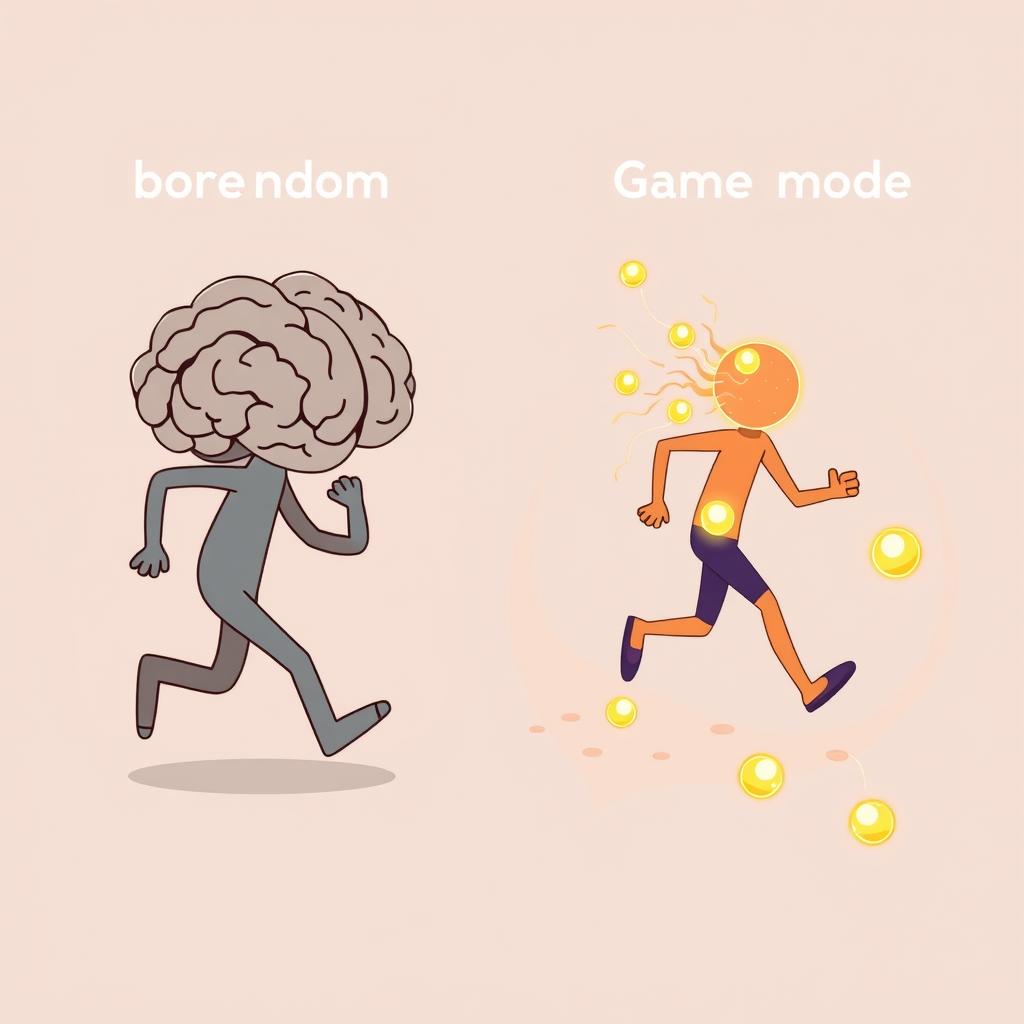
    A split illustration showing two brain states side by side, one labeled boredom with a gray running figure, one labeled game

    Third, and this is one that gets underestimated: time pressure with real consequences. The commitment device is one of the most powerful behavioral tools in existence. Behavioral economist Richard Thaler’s work on commitment contracts shows that when people put something at stake themselves, voluntarily, the follow-through rate jumps substantially compared to willpower-only approaches. A mission structure where you deposit real money, define a real distance goal, and either get it back plus a share of other people’s forfeited deposits, or lose it entirely, is not just motivating. It is psychologically sophisticated in a way that aligns with how Gen Z already thinks about accountability.

    💬 The Social Layer Nobody Talks About Enough

    Running has always had a social dimension, but it has historically been inaccessible to beginners. Local running clubs tend to attract people who are already serious runners, which creates an implicit intimidation barrier for anyone still figuring out a comfortable pace. The 5K feels embarrassing when everyone else is warming up for their marathon training run.

    Hyperlocal, app-mediated social layers solve this by creating communities organized around geography and shared starting points rather than performance level. When the leaderboard is your neighborhood and includes people who started the same week as you, competition becomes encouraging rather than humiliating. Real-time visibility of other runners in your area, even just seeing that someone a block away is currently on a run, creates a subtle but genuinely powerful sense of ambient social accountability.

    The social feed and club mechanics that good running gamification apps include are not frivolous. Research on exercise adherence consistently shows that social obligation is one of the most powerful predictors of sustained workout behavior. Telling people you run is surprisingly effective. Having those people watch you run, even passively through an app, is more effective still.

    📈 Building a Habit That Outlasts the Novelty Phase

    Here is the part that gamification skeptics get right: novelty fades. The treasure hunt that felt exciting in week one will feel routine by week eight unless the system is well-designed enough to keep evolving. This is why the best gamified fitness approaches use gamification as a scaffold rather than the structure itself.

    A diverse group of young urban runners celebrating together on a city street at golden hour, phones in hand, expressions of g

    The goal is not to run forever because a game told you to. The goal is to use the game’s reward loops to carry you through the first twelve weeks, which is roughly the window behavioral research suggests is needed to solidify an aerobic habit at a neurological level. By the time the gamification loses some of its novelty, you should have physiological and social hooks that sustain the behavior on their own. You feel genuinely better when you run. You have a group of people who expect to see you. You have a pace that feels comfortable rather than punishing. The game built the bridge; you are now on the other side.

    Practically, this means treating gamified running apps as a deliberate on-ramp. Use the missions, the stakes, the leaderboards with full commitment for the first three months. Set the hardest commitment challenge you believe you can realistically complete, not the safest one. Check the leaderboard more than feels cool to admit. Follow the local runners and actually cheer for them. Let yourself be a little too invested in finding the rare reward. That investment is doing real neuroscientific work on your behalf.

    🏁 The Takeaway: Stop Trying to Out-Discipline Your Own Brain

    Motivation slumps are not character flaws. They are predictable outputs of a brain that evolved to conserve energy and seek immediate rewards, trying to function inside a fitness routine that offers neither. The runners who make it to month four are not more disciplined than the ones who quit in week two. They have usually just found a structure that makes the effort feel worth it before the long-term benefits kick in.

    Gamification, done with genuine mechanical depth, is not a gimmick. It is an evidence-aligned way of making your brain’s reward system work with your fitness goals rather than against them. For Gen Z runners especially, who have a finely tuned detector for whether a feedback system is actually good, the quality of the gamification matters enormously. A streak counter will not cut it. What works is spatial novelty, real stakes, hyperlocal social competition, and a progression system that keeps unlocking something worth chasing.

    If you are in the early weeks of a running habit and the motivation is already wobbling, the honest answer is not to dig deeper into willpower. It is to redesign the game you are playing until winning it genuinely feels worth the run.

  • Why Gamifying Your Run Makes You 10x More Likely to Stick With It

    You downloaded three different running apps last January. You used them for a combined total of eleven days. Not eleven days each — eleven days total. And the thing is, you actually wanted to run. You had the shoes, the playlist, the intention. But somewhere between “I’ll go tomorrow” and “it’s raining again,” the habit just never stuck.

    If that’s you, you’re not lazy. You’re just fighting the wrong battle. The problem was never physical fitness — it was motivation architecture. And that’s exactly what gamification fixes, in ways that are way more scientifically grounded than the word “gamification” might suggest.

    Here’s a deep dive into the actual psychology of why turning your run into a game makes you exponentially more likely to lace up again tomorrow.

    The Motivation Gap That Kills Every New Runner 🧠

    Most people think motivation works like a light switch — you either have it or you don’t. The reality is more like a thermostat. It responds to environmental inputs, and the default setting for most human brains in 2024 is set against sustained voluntary discomfort.

    Running, at its core, asks your brain to accept immediate pain for a delayed reward. You hurt your lungs and legs right now. The reward — a leaner body, better stamina, longer life — arrives weeks or months later. Neuroscientifically, this is brutal. The human reward system runs on dopamine, and dopamine fires most powerfully when rewards are immediate, variable, and concrete. A “healthier future you” is none of those three things.

    Research from the University of Michigan found that when people exercise with an immediate, tangible reward attached to each session — as opposed to a long-term health goal — compliance rates jump by around 50 percent. That’s not a small margin. That’s the difference between a habit and a memory.

    This is the exact motivation gap gamification plugs. It doesn’t eliminate the physical difficulty of running. It restructures when your brain gets paid.

    Why Variable Rewards Are Basically Crack for Your Dopamine System 🎰

    Walk into any casino and you’ll notice one thing: nobody’s playing a machine that pays out every single time at a fixed rate. That would actually be boring. What keeps people glued to their seats is variable reward schedules — the slot machine that might pay out big, or might pay out nothing, and you never know which pull is the winner.

    B.F. Skinner identified this in the 1950s. Variable ratio reinforcement schedules produce the highest and most persistent rates of behavior of any reward structure. Your brain doesn’t just like unpredictability — it gets genuinely addicted to it, releasing dopamine not just when the reward arrives, but during the anticipation of it.

    This is why treasure hunt mechanics in running apps work so well on a psychological level. When you know a reward is waiting somewhere within a half-mile radius — but you don’t know exactly what it is, or exactly how far you’ll run before you reach it — your brain enters a state of motivated curiosity that feels completely different from “I should go run three miles.” The destination is concrete. The outcome is uncertain. That combination is neurologically irresistible.

    It also explains why a simple step counter, while useful, rarely sustains behavior long-term. Watching a number tick up is a fixed schedule. You always know exactly what you’ll get for each step. There’s no anticipation arc, no variable payoff, no reason for your dopamine system to get excited.

    Loss Aversion: The Psychological Force That Makes Commitment Devices So Powerful 💸

    Here’s a number that should change how you think about motivation: 2.5. That’s roughly how much more intensely humans feel a loss compared to an equivalent gain, according to Kahneman and Tversky’s foundational work on prospect theory. Losing twenty dollars genuinely hurts more than gaining twenty dollars feels good. This asymmetry is hardwired, not rational, and it’s one of the most exploitable cognitive biases in behavior design.

    Commitment devices use this asymmetry deliberately. The structure is simple: you put real money on the table before the behavior, with the explicit understanding that failure means you lose it. Studies from the Wharton School found that commitment contracts with financial stakes increased goal achievement rates by 30 to 40 percent compared to goals set without stakes.

    This isn’t about punishment for its own sake. It’s about making the “skip today” decision carry real weight. When skipping a run costs you nothing, your brain calculates the trade-off as comfort now versus abstract health later, and comfort wins almost every time. When skipping a run means losing actual money, that calculation flips. Suddenly inaction has an immediate, concrete, painful consequence — which is exactly the kind of signal the human brain takes seriously.

    What makes this even more effective when done well is the social dimension. Knowing that your forfeited deposit goes to people who actually completed their goals isn’t just punitive — it makes the social comparison vivid and real. Someone else finished what you didn’t. That reputational sting adds another layer of genuine motivation beyond the financial loss itself.

    Apps like Geowill have built this mechanism directly into the running experience through what they call a “burned bridges mission” — where you deposit real money, set a distance goal, and either earn it back by completing the goal or forfeit it to a shared pool for successful runners. It’s a nearly textbook application of commitment device psychology, and it’s exactly why this approach outperforms every “streaks” or badge-only system in the long run.

    The Power of Hyper-Local Social Proof 🏘️

    Motivation research consistently shows that our behavior is far more influenced by what people near us do than by global statistics or celebrity examples. This is called the social proof effect, and it works on proximity. Knowing that millions of people run marathons worldwide does almost nothing for your motivation. Knowing that your neighbor three blocks over ran 18 kilometers this week and is now ranked first in your district? That does something.

    There’s a specific psychological mechanism here called the similarity heuristic. We calibrate what’s possible for us based on people we perceive as similar to ourselves. When a world-class athlete runs a sub-three-hour marathon, most people’s brain quietly files that under “not relevant to me.” But when someone your age, in your neighborhood, on streets you recognize, is logging meaningful runs and earning community recognition — the gap between them and you suddenly feels closeable.

    This is why neighborhood-scale leaderboards and real-time runner visibility features are genuinely useful motivational tools, not just social media gimmicks. Seeing a small cluster of active runners in your immediate area creates a local norm. And humans are deeply, almost automatically, norm-following creatures. Once running in your neighborhood feels like something people here do, the activation energy to step outside drops considerably.

    The social features that actually move the needle are the granular ones: real-time local maps, district rankings, club runs with people from nearby streets. The broader the social scale, the less motivating it becomes. A global leaderboard where you’re ranked 847,203rd is demoralizing. A neighborhood leaderboard where you’re ranked 12th and climbing is a completely different experience.

    Progression Systems and the Zeigarnik Effect 🎮

    There’s a reason you feel slightly uncomfortable leaving a TV episode paused at the 70 percent mark. The Zeigarnik effect, named after Soviet psychologist Bluma Zeigarnik, describes the brain’s tendency to fixate on incomplete tasks more than completed ones. Your working memory literally stays open on unfinished goals like a browser tab you can’t quite close.

    Well-designed progression systems weaponize this. When your XP bar is sitting at 70 percent of the way to the next level, your brain experiences that as an open loop — a mild but persistent cognitive tension that pushes toward closure. Closing it feels good. Leaving it open feels subtly wrong.

    This is why pace zones, interval timers, and structured audio coaching work better as a bundle than as isolated features. Each one creates a small completion event within a single run. You finished the 90-second high-intensity interval. You hit the target pace zone for 10 consecutive minutes. You reached the checkpoint. Each micro-completion fires a small reward signal, turning a 40-minute run into a sequence of wins rather than a single long endurance test.

    The tiered reward structure matters here too. When you can visually see that legendary treasures unlock at level 30, and you’re at level 22, the specificity of the gap changes your relationship to the goal. “Keep running” is vague. “Eight more levels” is a project. The human brain handles projects much better than it handles open-ended commitments.

    What This Means for How You Actually Build a Running Habit 🏃

    Let’s put the psychology together into something actionable, whether or not you ever use a gamified app.

    First, attach an immediate reward to every single run, not just the long-term outcome. This can be as simple as a specific podcast episode you only let yourself hear while running, or a coffee from a particular place you only visit on run days. The reward needs to be immediate, concrete, and genuinely appealing to you.

    Second, use commitment devices. Tell someone publicly what you’re going to do and attach a real consequence to failure. Even informal social commitment — texting a friend your goal for the week — increases follow-through significantly. Financial stakes work best, but any form of public commitment helps.

    Third, make your social comparison local. Find out who in your neighborhood or workplace is running. Even one or two people running the same streets as you makes a measurable difference. The proximity matters more than the size of the community.

    Fourth, design for micro-completions. Don’t think of a run as one 30-minute thing. Break it into intervals, checkpoints, pace targets. Each small win counts neurologically, and accumulating small wins across a session changes how your brain files the experience afterward. You don’t remember “that was hard.” You remember “I hit every split.”

    The runners who actually stick with it long-term almost never rely on willpower or discipline alone. They’ve built environmental structures — social accountability, variable rewards, concrete short-term incentives, specific goals — that reduce the cost of showing up and increase the immediate payoff of doing so.

    Gamification isn’t a cheat code or a gimmick. It’s a systematic redesign of the reward architecture around a behavior your brain would otherwise deprioritize. When an app like Geowill puts a treasure location half a mile from your front door and real money on the line if you don’t hit your monthly target, it isn’t making running easier. It’s making the decision to run easier — which turns out to be the only thing that actually matters.

    You already know running is good for you. Your brain already knows that. The part that needs convincing isn’t your rational mind — it’s your reward system. And now you know exactly how to speak its language.

  • Why Your Morning Run Needs Gamification (And Real Money Stakes)

    Your alarm goes off at 6:47 AM. You set it with full intention last Sunday night — new week, new you, finally going to build that running habit. You pick up your phone, open your running app, stare at the blank start screen, and then spend the next eleven minutes scrolling through nothing in particular until it feels too late to bother. Sound familiar? You are not lazy. You are just not getting the right kind of push.

    Here is the thing most fitness advice gets wrong: motivation is not a personality trait. It is a design problem. And the solution is not willpower — it is understanding what your brain actually responds to and building a system around that.

    Why “Just Run More” Is Terrible Advice 🧠

    The traditional approach to building a running habit is basically this: decide you want to run, feel bad when you do not, try harder tomorrow. It treats motivation like a fuel tank that refills if you just feel guilty enough. Behavioral science disagrees pretty loudly with that model.

    What actually drives repeated behavior is a feedback loop — cue, action, reward. The problem with running is that the real rewards (better health, lower stress, improved sleep) are delayed by weeks or months. Your brain, operating on ancient survival software, does not naturally prioritize rewards that far out. It prioritizes what feels good in the next two minutes. Staying in bed wins that contest almost every time.

    Gamification is not a gimmick layered on top of fitness. It is a direct intervention in the feedback loop. When you earn points, unlock a level, or hit a streak, your brain gets a small but real dopamine hit right then. You are no longer waiting three months for cardiovascular improvement to feel like this was worth it. You feel the reward today, on this run, in this moment.

    Research published in the Journal of Medical Internet Research found that gamified health interventions increased physical activity significantly more than non-gamified ones, particularly in the 18 to 35 age range. The mechanism is not complicated: frequent, immediate rewards build the habit faster than rare, delayed ones.

    The Psychology of Progress Bars and Points 🎮

    Think about why you have ever kept playing a mobile game well past the point of it being actually fun. The answer is almost always visible progress. You could see your character leveling up. You could see the percentage bar filling. You were, objectively, getting somewhere — and your brain desperately wanted to see that bar hit 100.

    Three runners lined up at a race starting line ready to sprint

    Running apps that only show you raw data — pace, distance, calories — are missing this entirely. Those numbers are abstract unless you already care about them deeply. A 5k at 6:45 per kilometer means something to an experienced runner. To someone three weeks into a new habit, it is just numbers on a screen.

    What changes behavior is relative progress. Not how fast you ran, but how much further you got than last time. Not how many calories you burned, but that you just unlocked a new distance badge. XP systems, leaderboards, and tiered rewards translate the abstract into the concrete and the long-term into the immediate.

    There is also a social dimension that matters enormously here. Seeing that someone in your neighborhood ran 8km this morning while you have logged zero does something that a calorie chart simply cannot. It creates what researchers call social proof — evidence that people like you are doing the thing you want to do — combined with a gentle competitive nudge. Neighborhood-based leaderboards are psychologically more potent than global ones, because global rankings feel unreachable. A local leaderboard with people who literally live on your street? That is a completely different emotional calculation.

    Where Treasure Hunts Change the Game Entirely 🗺️

    Point systems and streaks work, but they still share one weakness: you are running the same routes, doing the same loops, racking up the same kind of reward every time. Predictability eventually kills motivation. When you already know exactly what you will get and roughly what the experience will feel like, the anticipation — which is actually the biggest driver of the dopamine response — disappears.

    Location-based running mechanics solve this by making every run genuinely unpredictable. The premise is simple: rewards are hidden in the real world and tied to actual GPS coordinates in your neighborhood. You have to physically go there to collect them. The destination changes. The route changes. The outcome is uncertain. That uncertainty is not a bug — it is the entire point.

    This structure borrows directly from variable reward psychology, the same principle that makes slot machines compelling and mystery boxes impossible to resist. When you know a reward is coming but not exactly when or how good it will be, you pay attention in a completely different way. Applied to running, it transforms a familiar neighborhood into a space full of possibility rather than a boring loop you have memorized.

    An app called Geowill is built entirely around this idea — treasure icons appear on a live map around you at specific times like after work or in the morning, and you have to actually run to within 100 meters of that location to claim them. The treasures come in different grades, from common to legendary, with higher levels unlocking rarer drops. The result is that you stop thinking about the run as exercise and start thinking about it as an expedition. Your neighborhood feels genuinely different.

    The Real Money Factor: Why Skin in the Game Is a Superpower 💸

    A determined runner mid-stride with sweat on their face, dynamic motion

    Here is where we move past gamification into something with sharper teeth. Points and treasure are powerful for building initial engagement. But for long-term commitment — the kind that survives a rainy Wednesday when you really do not want to go — nothing beats a financial commitment device.

    The concept comes from behavioral economics and was formalized by economists Richard Thaler and Shlomo Benartzi in research on retirement savings. The core insight is this: humans are loss-averse in a way that is not rational. We feel the pain of losing money roughly twice as strongly as we feel the pleasure of gaining the same amount. In practical terms, that means putting $20 on the line hurts more than winning $20 feels good.

    A commitment device exploits this asymmetry deliberately. You agree in advance that if you fail to meet a specific, measurable goal, you lose money. Not to an abstract charity you chose for maximum distance from your daily life — but to other people who succeeded at the exact thing you failed to do. That framing matters. Knowing that your failure literally funds someone else’s reward is motivationally brutal in the best possible way.

    Studies from stickK.com, a platform built on this exact mechanism, show that users who put money on the line complete their goals at significantly higher rates than those who use social accountability alone. When researchers controlled for how much money was at stake, even small amounts — $10, $15 — produced measurable behavior change. The amount matters less than the fact that something real is at stake.

    The Geowill version of this is called a Burn-Bridge Mission, which captures the psychological dynamic well. You set a distance goal, put down a deposit, and if you hit the goal within the time window, you get the full amount back. If you miss it, the money goes into a reward pool for runners who succeeded. No charity abstraction. No vague social consequence. Just the concrete knowledge that your failure becomes someone else’s literal gain.

    This is not about punishment for its own sake. It is about bringing a future consequence into the present moment. When you are lying in bed at 7 AM deciding whether to run, your future health is still months away. But your deposit? That loss is happening right now if you do not move.

    Building Your Own Gamified Running System 🛠️

    You do not need to install any specific app to apply these principles. Here is how to build the psychological stack yourself.

    A running coach pointing at a training schedule with a runner listening attentively

    Start with the variable reward layer. Pick five to eight locations within 2km of your home — a specific bench, a mural, a corner store, anything concrete. Write them on slips of paper. Each morning, draw one at random. That is your destination. Your run is not “going out for 30 minutes.” It is “getting to the red mailbox on Yeonnam-dong corner.” This single change makes every run structurally different and gives you a genuine endpoint to reach.

    Add a social visibility layer. Find one other person in your neighborhood — a friend, a neighbor, someone from a local running group — and share your weekly distance total with them every Sunday. The visibility alone creates low-level social pressure that punches above its weight in behavioral terms.

    Then add the money layer. Use a free commitment contract app or simply write a note to someone you respect: if I do not run X kilometers by X date, I owe you Y amount in cash. Make it real enough to sting but not so punishing that you abandon the whole system on day three.

    Finally, track progress visibly. A paper calendar on your wall where you mark each run day works better than a hidden app stat for many people, precisely because it is visible and social. Streaks on paper feel breakable in a way that hurts.

    The Bottom Line 🏁

    The reason most running habits fail is not effort — it is architecture. When the feedback loop between effort and reward is measured in months, your brain will always find a reason to opt out today. Gamification compresses that loop into minutes. Financial commitment devices make the cost of skipping real and immediate. And location-based mechanics make each run feel like something worth actually showing up for.

    You do not need to become a competitive runner or sign up for a half marathon to make this work. You just need to stop treating motivation as something you either have or do not have, and start treating it as a system you design. Put something real on the line. Make the destination surprising. Let other people see you moving.

    The alarm is going to go off again tomorrow morning. The difference is what you have set up in advance that makes getting up the easier choice.

  • Why Your Running Motivation Dies After Week 2 (And How Gamification Fixes It)

    You downloaded the running app on a Monday. You ran Tuesday, Thursday, and even Saturday. You felt genuinely good about yourself. Then week two arrived, it rained on Wednesday, you skipped once, and somehow that one skip became the permanent end of your running career. Sound familiar?

    This is not a willpower problem. This is not a discipline problem. This is a neuroscience problem, and once you understand exactly what is happening inside your brain during those first two weeks, you can actually do something about it.

    🧠 The Week 2 Drop-Off Is Shockingly Predictable

    Research from University College London puts habit formation somewhere between 18 and 254 days, with the average sitting around 66 days. Yet most running apps, coaches, and well-meaning friends act like two weeks of consistency should have you locked in for life. It will not. Two weeks is the exact point where the novelty has worn off but the habit has not yet formed.

    Here is what happens neurologically. When you start running, everything is new. Your brain releases dopamine not because of the run itself, but because of the novelty — the new gear, the new route, the new identity you are building. This is called the exploration phase, and your brain is basically giving you free dopamine samples. By day 10 to 14, novelty fades. The brain has categorized running as a known activity, the free dopamine stops, and now the actual work of habit formation has to begin. If there is no reward structure in place to bridge that gap, your motivation evaporates on schedule.

    This is why so many people describe running as something they “used to do.” The quit always happens in the same window because the brain’s reward system follows a predictable timeline, not a character flaw timeline.

    📉 The Reward Gap Nobody Talks About

    Traditional running advice focuses almost entirely on intrinsic motivation — run because it makes you healthier, because it clears your head, because future-you will thank you. All of that is true and none of it is sufficient for a beginner in week two.

    Intrinsic motivation requires you to already feel the benefits strongly enough to choose discomfort voluntarily. For someone who has been running less than two weeks, the physical benefits are minimal. Your cardiovascular system is barely beginning to adapt. You are still sore. You are still slow. The promised land of runner’s high and effortless five-kilometer jogs is weeks away, and your brain knows it.

    A young person lacing up bright sneakers at sunrise on an empty city street, looking determined and energized

    The technical term for this is temporal discounting. Humans systematically undervalue rewards that are far in the future and overvalue comfort that is available right now. Skipping today’s run gives you immediate relief. Running today gives you a health benefit that will show up in six to eight weeks. From your brain’s perspective, this is not even a close decision.

    This is exactly where external reward structures stop being a crutch and start being a legitimate tool. You are not cheating the system by making running feel rewarding in the short term. You are compensating for a very real gap between effort and payoff.

    🎮 Why Gamification Works When Willpower Does Not

    Gamification is a word that gets thrown around casually, but the specific mechanisms matter enormously. Not all gamification is created equal. Slapping a badge on an activity does almost nothing for long-term motivation. What actually works involves three things: variable rewards, social stakes, and progress that is visible in real time.

    Variable rewards are why slot machines are more compelling than vending machines. If you always know exactly what you are getting, your brain stops paying attention. Running apps that give you the same congratulations screen every time you finish a run stop feeling meaningful within a week. But if the reward is unpredictable — sometimes nothing, sometimes something rare — your dopamine system stays engaged because it is always anticipating the possibility of something better.

    Social stakes are more powerful than most people admit. Public commitment theory, tested across dozens of behavioral studies, shows that people are significantly more likely to follow through on goals when other people know about them. The effect is strongest when there is something concrete to lose, not just a reputation to protect.

    Real-time visible progress solves the temporal discounting problem directly. Instead of waiting six weeks to see cardiovascular improvement, you can see an XP bar move, a rank change, or a map area you have now covered on foot. Your brain gets the signal that something happened, right now, because of what you just did.

    Apps that combine all three of these mechanisms are genuinely different from apps that track your runs and email you a weekly summary. One is giving your brain what it needs to stay engaged. The other is filing paperwork.

    💰 The Psychology of Putting Skin in the Game

    A split scene showing a person's brain with reward pathways lighting up while running past glowing treasure icons on a city m

    One of the most underused and most effective motivational tools in existence is commitment contracts with real financial stakes. The research behind this goes back to behavioral economists like Dean Karlan, who co-founded StickK.com, and the results are consistent: people who put money on the line are dramatically more likely to follow through on exercise goals than people who simply state their intentions.

    The mechanism here is loss aversion, first documented by Daniel Kahneman and Amos Tversky. Humans feel the pain of losing something roughly twice as intensely as they feel the pleasure of gaining the equivalent amount. A ten dollar loss hurts more than a ten dollar gain feels good. When your running goal has a deposit attached to it, every skipped session now has an immediate, concrete cost. You are no longer choosing between the discomfort of running and nothing. You are choosing between the discomfort of running and the pain of losing money.

    This is not a trick. It is a realignment of the reward structure to match how human brains actually work rather than how we wish they worked. Some newer fitness apps have built this directly into their goal systems. Geowill, for example, runs a mission mode where you stake a deposit on a distance goal — say twenty kilometers in a given period — and get it back in full if you succeed, or lose it to a shared pool if you fail. The design is psychologically sound because it creates both loss aversion pressure and social proof through the visible pool of people who did succeed.

    The important thing is that the number matters. Set a deposit that actually stings if you lose it. Twenty dollars feels different than two dollars. You know your own financial situation well enough to find the right number.

    🏘️ Why Running Alone Is a Structural Disadvantage

    Community is not a nice-to-have feature in fitness. It is a load-bearing wall. A meta-analysis published in the International Journal of Behavioral Nutrition and Physical Activity found that people who exercised with social support were significantly more consistent than those who exercised alone, regardless of initial motivation levels.

    The specific mechanism that matters most is identity alignment. When you start seeing yourself as part of a running community — even a loose, digital one — running stops being something you do and starts being part of who you are. Identity-based behavior is far more resistant to friction than goal-based behavior. You can negotiate your way out of a goal on a rainy Wednesday. It is much harder to negotiate your way out of who you are.

    Local community amplifies this effect. Running past someone in your neighborhood who recognizes you from a running group, or seeing that someone three streets away just logged a seven-kilometer run at 6 AM, creates social norms that are far more powerful than any personal goal-setting session. You are not just running. You are participating in something that people in your immediate physical world are also doing.

    A runner crossing a finish line marker on a neighborhood street surrounded by cheering friends and glowing achievement badges

    If you are currently running alone with no community connection at all, this is the single highest-leverage change you can make before you adjust anything else about your routine.

    🗓️ Building a Week 3 and Beyond System

    The practical takeaway from everything above is that your running setup needs to deliberately compensate for the week two drop-off, not hope that your motivation holds.

    First, design a reward system with variable outcomes built in. This could be as simple as running new routes you have never explored before, using a local treasure-hunt style app, or setting up a group challenge where what you earn depends on how you perform relative to others. Predictable rewards become invisible. Unpredictable rewards keep you engaged.

    Second, attach a financial commitment to your goal before you need it. Do not wait until you are already losing motivation. Set up a commitment contract at the start, when you are still enthusiastic, because that enthusiasm is what makes you set a stake high enough to actually matter.

    Third, find one human who will notice if you stop. Not necessarily a running partner who shows up at your door — that is a high-friction commitment that often fails. Just someone who will ask you about it next week. The awareness of being observed, even loosely, has a measurable effect on follow-through.

    Fourth, lower the entry bar for a bad day. A five-minute jog still counts. A walk with intention still counts. Keeping the streak alive on a hard day is worth more than the perfect workout you skip entirely.

    The week two wall is real, it is predictable, and it has nothing to do with whether you are a person who runs. It has everything to do with whether you have the right system in place to bridge a gap that your brain is going to create on a biological schedule. Build the bridge before you need it, and the wall stops feeling so tall.

  • Why Gamifying Your Run Beats Willpower Every Single Time

    You set your alarm for 6 a.m. You tell yourself tonight is the night you start running. You even put your shoes by the door. Then 6 a.m. arrives, or evening comes, and somehow you are watching a 47-minute documentary about deep-sea fish instead. Sound familiar?

    This is not a discipline problem. It is not a character flaw. It is just how human brains are wired, and understanding that wiring is the first step to actually getting outside and moving.

    The entire fitness industry has spent decades telling people to try harder, want it more, and find their why. But a growing body of research in behavioral science suggests that willpower is genuinely one of the least reliable tools you can use to build a new habit, especially one as physically demanding as running. Gamification, done right, sidesteps willpower almost entirely. Here is why that works, and how specific game mechanics map to real psychological levers in your brain.

    🧠 Why Willpower Is the Wrong Tool for the Job

    Willpower is a resource that depletes. Roy Baumeister’s landmark ego depletion studies showed that making decisions, resisting temptations, and managing emotions all draw from the same finite cognitive pool. By the time most people finish work, deal with commuter stress, and process their inbox, that pool is nearly empty. Asking your depleted brain to choose a hard thing like running over an easy thing like the couch is asking it to lift heavy when it is already exhausted.

    What makes this worse is that willpower feels more reliable in the future than it is right now. This is called the empathy gap. You plan tonight’s run with full confidence on Monday morning, because Monday morning you have a full tank. But tonight-you is a different person with a much emptier one.

    Gamification does not ask your tired brain to make a virtuous choice. Instead, it restructures the environment so that the interesting, rewarding option happens to also be the healthy one. You are not choosing to run because you are disciplined. You are running because there is something specific and novel out there waiting for you, and your brain has a very hard time ignoring novelty.

    🎮 The Neuroscience of the Reward Loop (and Why Games Nail It)

    A young person lacing up sneakers at sunset in an urban neighborhood, looking at their phone with a curious smile, city map g

    Here is the core mechanic that games exploit: dopamine is not primarily a pleasure chemical. It is an anticipation chemical. Neuroscientist Wolfram Schultz’s research in the 1990s demonstrated that dopamine neurons fire hardest not when a reward arrives, but when a reward is expected or possible. A certain outcome is actually less exciting to your brain than an uncertain one.

    This is why slot machines are so compelling. Variable reward schedules, where you sometimes win and sometimes do not, produce stronger dopamine responses than predictable ones. Video games are engineered around this principle. Every loot box, every random drop, every chest you open after clearing a dungeon is a dopamine delivery mechanism disguised as entertainment.

    Running, stripped of any external feedback, offers almost none of this. You go out, you run, you come back, you feel okay. The reward is delayed by weeks or months, and it is abstract. Your brain is not especially excited about abstract future fitness. It is very excited about opening a chest right now.

    This is why the treasure hunt mechanic is such a clever application of reward psychology. When running is structured around finding something specific at a real location, the dopamine release shifts from post-run satisfaction to pre-run anticipation. You are not dragging yourself to burn 400 calories. You are going to find out what is at that pin on the map two streets over. That is a fundamentally different brain state to be operating from.

    📍 Location-Based Mechanics and the Power of Tangible Goals

    Abstract goals fail people constantly. Research published in the Journal of Consumer Research found that proximal, concrete goals outperform vague long-term ones when it comes to sustaining effort. Telling yourself you want to get fit is nearly useless as daily motivation. Telling yourself you need to reach a specific corner three blocks away, right now, is concrete enough for your brain to act on immediately.

    Location-based running mechanics work because they collapse a large ambiguous goal into a series of small, specific ones. Each destination is unambiguous. You either got there or you did not. There is no room for the kind of goalpost-moving rationalization that kills most fitness plans. Did you run a little today? Not the question. Did you reach the marker? That is the question, and the answer is binary.

    This concreteness also solves the what do I do today problem, which is one of the most underappreciated barriers to consistent running. Most beginners stall not because they lack motivation on their best days, but because they lack structure on their average days. A route that exists because a treasure appears at a specific GPS coordinate removes the daily decision cost entirely. The app makes the plan. You just execute.

    A colorful diagram showing dopamine reward loops with small trophy icons, running shoes, and a glowing map pin connected by a

    Apps like Geowill that drop location-based challenges onto a live neighborhood map are directly addressing this planning friction. The treasure does not care whether you feel inspired. It just sits there, and the gap between knowing it exists and actually going to get it is short enough that your brain can bridge it with minimal willpower expenditure.

    💸 Loss Aversion and the Genius of Betting Against Yourself

    One of the most robust findings in behavioral economics is loss aversion. Kahneman and Tversky’s prospect theory demonstrated that losing a given amount of money is roughly twice as psychologically painful as gaining the same amount is pleasurable. Losing twenty dollars hurts about as much as winning forty dollars feels good.

    Commitment devices built on loss aversion are one of the few interventions that actually change behavior in controlled studies. A 2016 paper in the Journal of Health Economics found that weight loss participants who put up their own money as a financial stake lost significantly more weight than control groups given only goal-setting support. The pain of potential loss was a more reliable motivator than the anticipated pleasure of success.

    The burn-your-bridges mission format, where you deposit real money and forfeit it to other users if you fail your distance goal, is a direct implementation of this research. It transforms a soft social commitment into a hard financial one. The interesting twist in pooled formats is that your failure does not just disappear into an abstraction. It goes to someone else who succeeded. That specific framing adds a social dimension to the loss that makes the psychological sting even sharper, which in turn makes the deterrent even more effective.

    The key is that this mechanism works best when the stakes are real but not catastrophic. A deposit sized to create genuine discomfort if lost without creating financial hardship is the sweet spot behavioral researchers consistently identify. Ten to twenty dollars is often enough to change behavior; the amount is large enough to matter but small enough that setting it up feels manageable.

    🏘️ Social Accountability at the Right Scale

    Most fitness social features fail because they operate at the wrong scale. Global leaderboards are demotivating for beginners. Seeing that someone in another country ran 200 kilometers last month creates social comparison pressure with no actionable path to close the gap. It just makes you feel like a beginner, which you are, but feeling like one too intensely is a reliable way to quit.

    A confident runner crossing a finish line in a city park, friends cheering nearby, a leaderboard floating gently above them w

    Neighborhood-scale social features work differently. When the people on your leaderboard live within two kilometers of you, the comparison is close enough to feel relevant and far enough from your personal life that it carries social stakes without personal awkwardness. You might see the same runner at your local convenience store. That proximity creates light accountability without the suffocating pressure of telling your actual friends about your fitness goals, which most people instinctively avoid because the fear of judgment is so high.

    Running clubs organized around geographic proximity also leverage what sociologists call weak tie networks. Your close friends are forgiving of your failures. Strangers who share a neighborhood are just unfamiliar enough to make you want to show up. The social motivation is real, but it is low-stakes enough that it does not trigger the anxiety that often accompanies public commitment to a goal.

    🏆 What Actually Sticks: Building the Identity, Not the Habit

    The end goal of any gamified fitness system should be to become unnecessary. The best-designed gamification scaffolds you toward a point where the external rewards have helped you build a genuine internal identity as a runner. Research by Wendy Wood at USC on habit formation suggests that about 43 percent of daily behaviors are habits, performed with minimal conscious decision-making. Getting to that state requires enough repetition that the behavior becomes context-linked rather than willpower-dependent.

    Game mechanics accelerate this by compressing the timeline for early wins. In traditional running programs, genuine positive feedback, better sleep, improved mood, visible fitness changes, takes four to eight weeks to become noticeable. That is a brutal waiting period with almost no reinforcement signal. Gamification inserts artificial but real reinforcers at every session: a new badge, a higher rank, a rare treasure item, a completed mission. These short-term rewards are not substitutes for long-term health. They are bridges across the valley between starting and caring.

    The goal is that somewhere around week six or eight, something shifts. You stop running because the app has something interesting and start running because the run itself feels like yours. The treasure hunt was the on-ramp. The runner inside you is the destination.

    So the next time you set your alarm for a morning run and feel your motivation flickering, do not lecture yourself about discipline. Instead, ask a different question: have I given my brain something specific and interesting enough to go get? Willpower is the car alarm that keeps going off. A compelling reason to move is the thing that actually gets you out the door.

  • Why Your Running Motivation Dies After Week 2 (And How to Fix It)

    You downloaded the app, bought the new shoes, told three friends you were “getting into running,” and then ran four times in two weeks and completely stopped. The shoes are by the door. The app still has your first run saved. You feel a specific, annoying kind of guilt every time you walk past them.

    You are not lazy. You are not weak-willed. What happened to you is so predictable that sports psychologists have a name for the pattern, and understanding it is the first step to actually breaking through it.

    Why Week 2 Is the Graveyard of Running Goals 🪦

    The first week of running feels genuinely exciting. Your body is doing something new, your brain floods you with novelty dopamine, and you get to post about it. Week two is where the machinery breaks down, and the reason is neurological, not motivational.

    When you start any new behavior, your brain releases dopamine not as a reward for completing the activity, but in anticipation of a reward you expect. The technical term is “reward prediction error.” During week one, your brain is making wild predictions about the future version of you: fitter, faster, more energetic, maybe even impressive at a 5K. The dopamine hits are front-loaded. By week two, the gap between expectation and reality becomes visible. You are still slow. Your calves hurt. It is raining. The future-you dopamine fades because your brain has recalibrated its predictions, and suddenly running feels like pure effort with no immediate payoff.

    Here is the concrete number that makes this tangible: research from University College London found that, on average, it takes 66 days for a behavior to become automatic. Two weeks is day 14. You are not even a quarter of the way to habit formation when motivation typically collapses. This is not a personal failure; it is a timing problem.

    The “Intrinsic Motivation Trap” Nobody Talks About 🧠

    Every fitness article tells you to “find your why.” Run for your health. Run for your future self. Run because you deserve it. This advice is not wrong exactly, but it is dangerously incomplete for beginners, because intrinsic motivation requires a feedback loop that new runners simply do not have yet.

    Intrinsic motivation works beautifully once you are competent enough to feel progress. A runner who has been training for six months can feel the difference between a 6:30 pace and a 7:00 pace. They notice their breathing has improved. Running itself becomes the reward. But at week two, you are not there yet. You are still in the zone where every run feels equally hard, your pace improvements are invisible to your body, and “running for health” is an abstract future promise your brain refuses to treat as real currency.

    A young person lacing up bright sneakers at dawn on a quiet city street, looking determined and hopeful

    Psychologists call this the “competence gap.” Intrinsic motivation needs a sense of growing mastery to sustain itself, and that mastery takes months to develop. What beginners actually need is an external reward structure that bridges the gap until intrinsic motivation can grow. The mistake most people make is expecting themselves to feel internally motivated before they have earned that feeling through enough repetitions.

    So what fills the gap? Not willpower. External reward architecture — specifically, systems that make each individual run feel like it has a concrete, immediate outcome attached to it.

    What Gamification Actually Means (And Why Most Fitness Apps Do It Wrong) 🎮

    Gamification is one of the most misunderstood concepts in fitness. Most apps interpret it as badges and streaks. You ran three days in a row: here is a flame icon. The problem is that badges work for about two weeks, and then they stop working for the same neurological reason running itself stops working. Novelty fades; passive achievement icons do not create meaningful stakes.

    Effective gamification is built on three specific psychological levers: variable rewards, social comparison, and loss aversion. Almost every successful game uses all three simultaneously. Almost every fitness badge system uses none of them properly.

    Variable rewards are the reason slot machines are more addictive than vending machines. A vending machine gives you the same predictable output every time. A slot machine gives you uncertain, variable outputs on a random schedule, which keeps dopamine anticipation elevated across every single interaction. Applied to running, this means that if every run produces exactly the same result (a logged distance), your brain habituates to that outcome quickly. But if each run has the possibility of producing something different and unexpected, the dopamine anticipation stays engaged longer.

    Social comparison needs to be local and real to matter. Knowing that some anonymous user in a global leaderboard ran 200 miles last month does not activate your competitive instinct in any meaningful way. Knowing that your neighbor three blocks over just passed your XP score, and you can see their route on a map, creates an entirely different psychological pressure. Proximity makes comparison feel real.

    Loss aversion is the most powerful lever of the three. Research by Kahneman and Tversky consistently shows that people feel the pain of losing something roughly twice as intensely as they feel the pleasure of gaining the equivalent. If you put money on the table, the prospect of losing it will motivate you to act far more reliably than the prospect of gaining a reward of the same size. This is not a personality flaw; it is a feature of how human brains assess risk.

    The Science of Commitment Devices 💰

    A split brain diagram showing dopamine reward cycles on one side and a fading running streak calendar on the other

    The most underrated tool in behavior change is the commitment device, and behavioral economists have been studying them for decades. A commitment device is any mechanism where you voluntarily restrict your future choices or introduce a meaningful cost for failure, before you are in the situation where temptation will hit you.

    Odysseus asking his sailors to tie him to the mast before sailing past the Sirens is the classic example. He knew his future self would make a bad decision, so his present self created a constraint. Every effective diet plan, savings account with early-withdrawal penalties, and public accountability pledge is a commitment device.

    The key word is meaningful. If the consequence of failure does not actually hurt, the commitment device does not work. Telling your friends you will run this week costs you almost nothing if you fail — a mild social awkwardness you can easily rationalize away. But putting 20,000 won in a locked pool that gets redistributed to people who succeeded while you failed? That activates loss aversion at full force every single morning when your alarm goes off.

    Apps like Geowill have built this exact mechanic into their core — you stake actual money on a distance goal, succeed and get it back, fail and it flows to runners who hit their targets. What makes this psychologically different from simply “betting on yourself” is that the money does not disappear into a void; it goes to real, identifiable people who did the work. That specificity makes the loss feel more real and the potential shame more concrete, which is exactly what loss aversion requires to function properly.

    Building a System That Survives Week 2 🏗️

    Knowing all of this is useless without an action plan. Here is a specific, structured approach to engineering your way through the week-2 dropout zone.

    First, design your variable reward. Do not let every run produce the same output. This could mean choosing a different neighborhood route each time and treating it like mild exploration, or using a dice roll to decide your interval structure for the day, or setting small location-based goals where reaching a specific landmark feels like completing a micro-mission. The content of the variable reward matters less than the unpredictability of it.

    Second, make your social comparison hyperlocal. Do not track yourself against global leaderboards. Find one or two people in your immediate neighborhood — a coworker, a neighbor, a friend who lives nearby — and compare only against them. The psychological activation of local comparison is dramatically stronger than abstract global comparison. Even following a neighborhood running community on social media, where you recognize the street names in people’s photos, creates more useful competitive pressure than any global ranking.

    A runner arriving at a glowing marker on a city map at golden hour, arms raised in celebration with other runners nearby

    Third, create a real commitment device before week one ends. This is the critical timing. By the time motivation drops in week two, it is too late to impose a commitment on yourself because your motivated self has already left the building. Design the constraint while you still feel excited. This could be financial, as described above, or social — recording a video where you commit to a specific goal and giving it to a friend with instructions to post it publicly if you quit. The format matters less than the genuine cost of failure.

    Fourth, reduce friction for the runs that happen during the hardest window, which is roughly days 10 through 20. Lay your running clothes out the night before. Set your route on the map before bed. Have a playlist loaded. The moment you have to make three decisions before leaving the house, the demotivated brain finds a reason to skip each one.

    Fifth, reframe what counts as success during week two. One kilometer done is not a failure compared to five kilometers planned. It is a deposit into the habit bank. The research on habit formation shows that the frequency of the behavior matters far more than its intensity in the early stages. A 10-minute shuffle around the block, logged and completed, does more for long-term habit formation than a perfect 5K run that happens only once because it felt overwhelming to plan.

    What Actually Waits on the Other Side 🌅

    The runners who make it past the six-week mark almost universally describe the same turning point: the day running stopped feeling like something they were forcing themselves to do, and started feeling like something they actually wanted to do. This transition is real, it is neurological, and it happens when the habit groove in your brain deepens enough that the behavior becomes the default rather than the exception.

    But you cannot think your way to that point. You can only run your way to it, and the systems you build around weeks two through four are the scaffolding that holds you up until the intrinsic motivation finally kicks in on its own.

    The gamification solution that actually works is not one flashy app feature or one clever trick. It is a layered architecture of variable rewards, genuine social stakes, and well-timed commitment devices working together to give your brain enough reason to lace up the shoes on the days when pure willpower would fail. Which, if you are honest about it, is most days for the first couple of months — and that is completely fine.

    The goal is not to become someone who is always motivated. The goal is to build systems smart enough to work even when you are not.

  • Why Your Running Motivation Fails (And How to Actually Fix It)

    You downloaded a running app on a Monday. You ran on Tuesday. You ran again on Thursday, felt genuinely proud of yourself, told a friend about it. Then the weekend came, it rained a little, and you never opened the app again. Three weeks later you saw it on your home screen and deleted it without guilt. Sound familiar?

    That cycle is not a personal failure. It is a mechanical problem with how most people set up their relationship with running. And like any mechanical problem, once you understand exactly what is breaking, you can fix it.

    The science here is actually pretty clear, and the answers are more interesting than “just find your why” advice that fills every fitness blog on the internet.

    The Real Reason You Stop Running 🧠

    Most people frame running motivation as a willpower issue. You either have the discipline or you don’t. But behavioral scientists have studied this for decades, and the picture is more nuanced. The actual culprit in most cases is what researchers call a “reward delay gap.”

    Running is genuinely uncomfortable for the first four to eight weeks. Your cardiovascular system hasn’t adapted yet, your legs ache, and your lungs feel like they’re on fire after two blocks. The benefits, though — improved mood, better sleep, visible fitness gains — arrive weeks or months later. Your brain, which evolved to weight immediate outcomes far more heavily than future ones, does a simple calculation and decides this deal is bad. This isn’t weakness. This is a documented cognitive bias called hyperbolic discounting.

    A 2021 study published in Nature Human Behaviour found that people are significantly more consistent with exercise when they pair it with something immediately enjoyable — an audiobook only allowed during workouts, a preferred podcast, anything that creates a reward in the moment rather than someday. The workout itself becomes the path to something you actually want right now.

    The implication is important: the runners who succeed long-term are not people with stronger willpower. They are people who — consciously or not — have structured their running so that the immediate experience contains its own reward. Everything else follows from that.

    Why “Running for Health” Is Almost Always a Trap 🏥

    This one stings a little, but hear it out. Health is a terrible primary motivator for most people, and especially for people under 35.

    A young person sitting on their bed at dawn staring at running shoes on the floor, looking uncertain but hopeful, cozy bedroo

    The reason is abstract distance. “My cardiovascular health will be better in ten years” is genuinely not compelling to your nervous system at 7 AM when the bed is warm. It’s not that people don’t care about their health. They do. It’s that health as a goal has no feedback loop that operates on a human timescale for a beginner. You cannot feel your VO2 max improving. You cannot see your arteries getting more flexible. The benefit is real but invisible.

    Compare this to “I want to run a 5K in under 30 minutes by March” or even something as immediate as “I want to feel less winded climbing the stairs at work.” Both of those have a concrete, verifiable feedback signal. You either did it or you didn’t. There’s a moment of reckoning that health goals almost never produce.

    The fix is not to abandon caring about your health. It’s to demote health to a background benefit and find a foreground goal with sharp edges — something you can succeed or fail at in a clearly defined timeframe. Time-bound, measurable, slightly uncomfortable. That’s the structure your brain can actually work with.

    The Social Layer Almost Nobody Uses Correctly 👥

    “Run with a friend” is advice that gets handed out like candy, and it does work — when it’s set up right. But most people’s version of it is too soft to do much. “My friend also runs sometimes” is not accountability. It barely qualifies as company.

    What actually creates behavioral change is public commitment combined with real consequences. This is called commitment device theory, and it was popularized by economists like Richard Thaler and Shlomo Benartzi in the context of savings behavior before it migrated into fitness research. The basic idea: people dramatically increase follow-through when they have made a commitment that costs them something real if they break it.

    A study from the Dominican University of California found that people who wrote down their goals and shared them with a friend had a 76 percent success rate compared to 43 percent for people who just thought about their goals. The act of public declaration makes the goal real in a way that private resolution never quite does.

    But the most potent version of this isn’t just telling a friend. It’s putting actual money on the line. Research from the University of Pennsylvania showed that financial incentives tied to behavior — specifically the loss framing, where you risk losing money you already have rather than potentially gaining a reward — are significantly more effective at changing behavior than almost any other intervention. Losing 20 dollars feels about twice as bad as gaining 20 dollars feels good, neurologically speaking. That asymmetry is a lever.

    Apps built around this insight, like Geowill’s “burn your bridges” mission where you stake a deposit against a running goal and forfeit it to other successful runners if you fail, are tapping directly into this research. It’s not gimmicky. It is one of the most behaviorally sound motivation structures that exists. Whether you use an app or set up your own version with a friend and a Venmo agreement, the principle is the same: make failure materially cost you something, and you will show up.

    A split scene showing a runner checking a phone map with glowing markers on a neighborhood street at dusk, surrounded by smal

    Why Your Running Route Matters More Than Your Playlist 🗺️

    This sounds counterintuitive because the running playlist is treated as sacred. But there’s a strong case that the environment you run in does more for consistency than audio ever will.

    Environmental psychology research consistently finds that novel, stimulating environments increase dopamine release. Dopamine isn’t just the “pleasure chemical” — it’s more accurately the “anticipation and seeking” chemical. Running the same loop around your block every day flattens novelty to zero, which means dopamine drops, which means your brain starts treating the run as a chore rather than an exploration.

    The practical implication: deliberately introduce route variety, even in small ways. A different turn, a street you’ve never checked out, a park entrance you always pass but never use. The bar for novelty is genuinely low. Your brain doesn’t need a mountain trail. It needs something to be curious about.

    This is also why scavenger-hunt style running — where your goal is to physically reach specific locations in your neighborhood — works so well as a motivation structure for beginners. You’re not running to run. You’re running to get somewhere specific, with a clear arrival point. The finish line is right there on the map, a few blocks over. That’s a completely different psychological experience from “just go run for 30 minutes.”

    Building the System, Not Just the Streak 📅

    Habit stacking is one of the most practical tools in behavioral science and it’s weirdly underused by people trying to build a running habit. The concept, laid out clearly in BJ Fogg’s work at Stanford, is that new behaviors attach much more reliably to existing ones than they do to abstract intentions.

    “I will run three times a week” is an intention. “After I close my laptop at the end of the workday, I will change into running clothes” is a habit stack. The second one has an anchor — a specific, concrete existing behavior that automatically cues the new one. You’re not relying on motivation in the moment. You’ve pre-decided.

    The specifics matter a lot here. The more precisely you define the trigger, the better it works. Not “after work” but “when I close my laptop and unplug my charger.” Not “on weekend mornings” but “right after I make my first cup of coffee on Saturday.” The behavior should snap onto the anchor like a latch.

    A smiling runner stretching on a park bench after a run, phone in hand showing a completed route, neighborhood trees in the b

    Combine this with the two-minute rule for bad days: on days when you genuinely don’t feel it, your only commitment is to put on your shoes and walk out the door. Two minutes. That’s it. What actually happens most of the time is that you run, because starting is the entire battle. On the occasional day you don’t run after two minutes, you still reinforced the cue-behavior chain, which keeps the habit alive.

    Track something, but track the right thing. Don’t track your weight or your pace in the early weeks. Track streak days, total runs completed, or neighborhoods visited. These are things entirely within your control and they create a visible record of identity — you are someone who runs, and here is the evidence.

    What Actually Gets You to Six Months 🏆

    The runners who stick past the six-month mark — the point where running becomes genuinely enjoyable and automatic — almost universally have a few things in common. They have a community, even a small one. They have a goal with a deadline. They have made their runs interesting rather than purely functional.

    None of this requires expensive gear, a gym membership, or a perfect schedule. It requires designing your running environment thoughtfully instead of muscling through on motivation alone. Motivation is a feeling, and feelings are unreliable. Systems are not.

    The honest takeaway here is that almost anyone can become a runner. The people who say they are “just not a runner” are usually people who tried to run on pure willpower without addressing the reward gap, without public commitment, without route variety, without a behavioral anchor. They didn’t fail at running. They ran a system designed to fail.

    Fix the system. The running takes care of itself.

    If you want a concrete starting point that bundles several of these principles together — novelty routing, financial commitment stakes, neighborhood social competition — it’s worth looking at what Geowill is doing with location-based treasure collection combined with their deposit-on-the-line goal structure. It’s a neat real-world example of behavioral science applied to exactly this problem. But whether you use an app or build your own version with a spreadsheet and a friend group chat, the underlying mechanics are available to everyone. The psychology isn’t secret. You just have to use it.

  • Why Your Running Goals Keep Failing (And How a Money-Back Guarantee Changes Everything)

    It is January 8th. You have a new playlist, new shoes that cost more than your last three grocery runs combined, and a note on your phone that says “5K by March.” By January 19th, the shoes are under your bed and the playlist is just playing in the shower. Sound familiar?

    You are not lazy. You are not undisciplined. You are just running headfirst into a psychological wall that almost everyone hits, and nobody talks about clearly enough. The frustrating part is that the solution has existed in behavioral economics for decades — it just never made its way cleanly into the fitness world until recently.

    Let’s break down exactly why running goals collapse, and then look at the one mechanism that actually rewires the whole equation.

    🧠 The Real Reason “I’ll Start Running” Never Survives Week Two

    Most people blame motivation. Motivation is not the problem. Motivation is actually pretty strong on day one. The problem is that motivation is an emotion, and emotions are unstable. What you actually need is a structure that works even when motivation has completely left the building.

    Here is what happens neurologically. When you imagine your future self running a 5K, your brain lights up in the reward centers. It feels almost as good as actually doing it. Researchers call this “mental simulation substitution” — your brain partially satisfies the goal just by imagining it vividly. So you get a micro-dose of accomplishment before you even put on your socks. Then the alarm goes off at 6 AM on a Wednesday, it is cold, your bed is warm, and the emotional reward for running is suddenly much smaller than the immediate comfort of staying still.

    The gap between intention and action is not a character flaw. It is a predictable feature of how human brains prioritize immediate pleasure over distant rewards.

    😬 Why Accountability Apps and Streaks Mostly Do Not Work

    The fitness industry’s standard answer is accountability. Track your streak, post on Instagram, join a challenge. These work short-term but collapse for a specific reason: the cost of quitting is too low.

    Why Your Running Goals Keep Failing (And How a Money-Back Guarantee Changes Everything)

    When you break a Duolingo streak, you feel a little bad for about four minutes. When you miss a gym check-in on an app, nobody actually loses anything tangible. The emotional pain is mild and short-lived. Humans are wired to respond much more strongly to loss than to the absence of gain — this is called loss aversion, and it is one of the most replicated findings in all of behavioral science.

    Daniel Kahneman and Amos Tversky’s research found that losses feel roughly twice as powerful as equivalent gains. Meaning: losing twenty dollars hurts about as much as gaining forty dollars feels good. Most fitness apps only work on the gain side of that equation. They reward you for showing up. But they barely touch the loss side.

    Streaks break without real consequence. Badges accumulate in apps nobody opens anymore. The pain of skipping is just not big enough to override the comfort of your couch at 7 AM.

    💸 What Actually Changes When Real Money Is on the Line

    Here is where behavioral economics gets genuinely interesting for runners specifically.

    In 2008, researchers at Yale ran a smoking cessation study where participants either got standard support or deposited money into an account they would lose if they did not quit. The deposit group quit at nearly double the rate. A similar study in the Journal of Health Economics found that financial commitment contracts increased gym attendance by up to 33 percent compared to standard incentive programs. The mechanism is not the reward of getting money back — it is the active, present-tense dread of losing what is already yours.

    This is called a commitment contract, and it works by flipping the psychological framing. Instead of “I might earn a reward if I succeed,” the structure becomes “I will lose something real if I quit.” That triggers loss aversion, which is a much more durable motivator than excitement or hope.

    The commitment contract has been used in economics, public health, and personal finance for years. Its application to running is surprisingly direct. You set a specific goal — say, running three times a week for four weeks. You put a deposit down. You hit the goal, you get every cent back. You do not hit it, the money is gone. The daily decision to run is no longer “do I feel like it?” but “do I want to lose that money?”

    That is a fundamentally different question, and your brain processes it very differently.

    Why Your Running Goals Keep Failing (And How a Money-Back Guarantee Changes Everything)

    🗺️ The Missing Ingredient Most Fitness Science Ignores: Fun

    Even if the financial commitment architecture is solid, pure loss aversion gets exhausting as a solo motivator. Nobody wants their health routine to feel like a hostage situation. This is where the most successful running programs layer in something the pure-accountability crowd tends to dismiss: genuine enjoyment during the run itself.

    Game design researchers have studied this carefully. The most habit-forming experiences combine what they call extrinsic stakes (consequences, rewards) with intrinsic engagement (the activity itself is interesting moment to moment). Running only scores well on neither for most beginners. The stakes are vague and future-focused, and the activity itself — just moving your legs on the same sidewalk — is repetitive before you build enough fitness to find the physical flow enjoyable.

    One approach that directly addresses this is GPS-based exploration. When your run has a geographic objective — finding a route that passes through specific coordinates, discovering new streets, hunting for virtual waypoints placed on a real map — the run itself becomes a navigation puzzle. Your attention shifts from “how much longer do I have to do this” to “what is around this next corner.” This is not a gimmick. It recruits the same curiosity loop that makes open-world video games so sticky, applied to actual outdoor movement.

    Apps like Geowill combine exactly these two layers — the financial commitment contract mechanism alongside GPS treasure hunting on a live map — which is a rare pairing of the loss-aversion backbone with moment-to-moment engagement. Neither layer alone is as durable as both together.

    🏃 Building a Running Goal That Is Actually Structured to Survive

    If you want to set a running goal that sticks before you rely on any app or system, here is the specific architecture that behavioral research supports.

    Make the goal binary and verifiable, not fuzzy. “Run more” is not a goal. “Run 2.5 miles three times per week for six weeks” is a goal. It is either done or it is not, with no room for self-negotiation.

    Set a short time horizon first. Six weeks is more neurologically manageable than six months. Your brain can actually picture six weeks. It cannot meaningfully imagine six months, so distant goals get deprioritized automatically. Stack multiple six-week cycles rather than setting one enormous annual goal.

    Why Your Running Goals Keep Failing (And How a Money-Back Guarantee Changes Everything)

    Attach a real cost to quitting. Tell three specific people your goal and the exact consequence of failing — whether that is a financial deposit, a social embarrassment, or donating to a cause you actively dislike. The specificity matters. Vague social pressure evaporates. “I told my work team I run 15 miles by March 15th and Jae gets to pick my Slack username if I miss it” is pressure that will cross your mind on a tired Tuesday morning.

    Shrink the minimum viable run. Research on habit formation consistently shows that lower activation energy produces more consistent behavior. Telling yourself your only commitment is to put on running shoes and step outside removes the psychological mountain of “I have to do a full workout.” On days where you genuinely have ten minutes, ten minutes done consistently beats forty minutes planned but skipped.

    Run with geographic intention at least once a week. Pick a street you have never been down. Run toward a landmark you have only ever driven past. This sounds trivial but it creates what psychologists call a “novelty reward” — the small dopamine hit of new sensory experience — which keeps the activity associated with curiosity rather than drudgery.

    🏆 The Takeaway: Change the Stakes, Not the Willpower

    The runner who sticks with it for a year is usually not the person with the most discipline. They are the person who built an environment where quitting had clear, immediate costs and showing up had genuine moment-to-moment rewards.

    Willpower is a depletable resource. Decision fatigue is real. On the day you got three hours of sleep, skipped lunch, and had a brutal meeting, asking your brain to override comfort through sheer resolve is asking a lot. But “do I want to lose the two hundred dollars I already committed?” bypasses the willpower system almost entirely. It is a simple calculation, not a motivational pep talk.

    The most honest thing you can do for your running goals right now is to stop trying to feel more motivated and start engineering better stakes. Put something real on the line. Make the run itself interesting, not just the outcome. Keep the time horizon short enough that your future self feels like a real person who will actually care.

    Running is genuinely one of the most accessible, powerful things you can do for your health. The barrier is almost never physical fitness — most people can run-walk a mile right now if they had to. The barrier is the invisible negotiation that happens in your head every morning between what you planned and what is comfortable. Fix that negotiation by changing its terms, not by trying to want it more.

  • Why Your Running Motivation Fails (And How Skin in the Game Changes Everything)

    You downloaded a running app on January 2nd. You ran four times that first week. You felt genuinely good. By February 10th, you had not run in three weeks and you were actively avoiding looking at the app icon on your phone.

    If that sounds familiar, you are not lazy and you are not weak. You are just using the wrong motivational system for the wrong kind of person. The standard fitness advice — set a goal, stay consistent, believe in yourself — works for maybe 10 percent of the population. For the rest of us, there is a more honest and more effective way to think about why we stop running, and what actually gets us back out there.

    This is not another “find your why” post. This is about behavioral economics, a little bit of controlled fear, and why putting something real on the line might be the only thing that finally works for you.

    The Motivation Myth Nobody Talks About 😬

    The fitness industry has a financial incentive to sell you the idea that motivation is a feeling you can generate on demand. Buy the right shoes, listen to the right playlist, find your inner fire. But sports psychologists have known for decades that motivation is not a reliable engine. It is a spark. And sparks die.

    What actually drives sustained behavior is not motivation. It is friction and reward architecture. Research from the University College London suggests that on average it takes 66 days to form a habit, not the 21 days you have probably heard. More importantly, the study found huge individual variation — for some people it took 18 days, for others it took 254 days. That range means there is no universal timeline, and feeling like you failed after two weeks is biologically uninformed.

    Here is the real problem with relying on motivation alone: motivation is highest when you have done nothing yet. You feel pumped the night before your first run. You feel absolutely nothing useful at 6:30am when the alarm goes off and it is raining. Motivation is a pre-game emotion, not a mid-game fuel source.

    Why Runners Specifically Quit in Week Three 🗓️

    Running has a uniquely brutal early phase. Unlike cycling or swimming, there is almost no beginner zone where it feels comfortable. Your first few weeks of running involve genuine physical discomfort — your lungs burn, your shins ache, your pace is embarrassingly slow. This is not a personal failing. This is just what happens when your aerobic system and musculoskeletal structure adapt to new stress.

    The problem is that your brain’s reward system expects returns proportional to effort. You are working hard, sweating, and your pace is still a 12-minute mile. The effort-to-reward ratio feels terrible. This is why most runners quit somewhere between day 14 and day 21. It is exactly when the novelty has worn off but the physiological adaptations have not yet arrived.

    Why Your Running Motivation Fails (And How Skin in the Game Changes Everything)

    Studies on exercise dropout consistently show that perceived enjoyment drops sharply in weeks two through four, then climbs again around week six to eight as fitness improvements become noticeable. The problem is most people never reach week six because they interpret the week-three slump as evidence that running is simply not for them.

    It is not a personality issue. It is a timing issue. You are quitting right before the breakthrough.

    The Psychology of Skin in the Game 💸

    In 2002, psychologists Daniel Kahneman and Amos Tversky formalized what most poker players already understood: losing something hurts roughly twice as much as gaining something of equal value feels good. This is called loss aversion, and it is one of the most robustly replicated findings in all of behavioral science.

    The practical implication is enormous. If you want to create a behavior change that sticks, making someone afraid to lose something is more powerful than promising them a reward. A five-dollar loss will motivate you more than a five-dollar gain. A fifty-dollar loss will genuinely change your week.

    This is the logic behind commitment contracts, a technique used in behavioral economics interventions for health, productivity, and financial goals. The structure is simple: you declare a specific goal, you put up real money, you get it back if you succeed and lose it if you fail. Research from a 2008 study published in the Journal of Political Economy found that commitment contracts increased smoking cessation rates by 53 percent over a control group. A 2016 study on exercise specifically found that financial commitment devices increased gym attendance by 30 percent over a semester.

    The mechanism is not really about the money itself. It is about making failure tangible. When failure is abstract — I just did not run today, oh well — your brain files it under low-priority regret. When failure means your $40 deposit is gone and distributed to people who actually did run, your brain recategorizes it as a real loss. That recategorization happens before you decide whether to lace up your shoes, which is exactly when it needs to happen.

    Building Your Own Commitment System From Scratch 🛠️

    You do not need an app or a platform to start using this principle. Here is how to build a basic commitment contract yourself.

    Why Your Running Motivation Fails (And How Skin in the Game Changes Everything)

    First, define a precise goal. Not “run more” but “run at least 3 times per week for 4 consecutive weeks, each run at least 20 minutes.” Vague goals cannot be lost. Precision is what makes the loss real.

    Second, choose a referee. This needs to be someone who genuinely will not let you off the hook. Your best friend who always takes your side is a terrible choice. Your slightly competitive coworker or a running partner you met online is better. The referee’s job is not to punish you — it is to confirm completion objectively.

    Third, set a stake that actually hurts. Behavioral economists suggest the sweet spot is roughly two to five percent of your monthly income. High enough to make you think twice, not so high that anxiety becomes counterproductive. If you earn $3,000 a month, somewhere between $60 and $150 is a real stake without being destabilizing.

    Fourth, choose a loss destination that you hate. Research shows the effect is significantly stronger when your money goes somewhere you actively dislike. A political cause you oppose, a rival sports team’s merchandise fund, an ex’s favorite charity. The point is that neutral loss is much weaker than directed loss.

    Fifth, make your goal public in at least one specific community. Telling five people on Instagram is not the same as telling a specific group of people who will notice whether you followed through. A local running group, a Strava club, a Discord server with real people who run — these create social accountability that amplifies the financial stake.

    Some platforms formalize exactly this kind of system. Geowill, for instance, built their entire core loop around what they call a “배수진 mission” — the Korean concept of burning your boats so there is no retreat — where users deposit real money, declare a running goal, and if they succeed they get everything back plus a share of deposits from people who did not. The loss aversion mechanism and the community element are both built into one structure, which removes the friction of setting it up yourself.

    Why Gamification Works When It Is Done Right 🗺️

    Gamification has a bad reputation because most of it is shallow. Virtual badges and empty streaks do not change behavior long-term. But when game mechanics map onto real behavioral psychology, something genuinely different happens.

    The key distinction is between extrinsic rewards that replace intrinsic motivation and game structures that manufacture intrinsic rewards. Running for a virtual badge you do not care about is the former. Running through your actual neighborhood toward a GPS-located item on a real map creates a different kind of engagement — one that taps into spatial curiosity, the same cognitive system that makes you want to see what is around the next corner on a hike.

    Why Your Running Motivation Fails (And How Skin in the Game Changes Everything)

    Research on gamification in health apps consistently shows that GPS-based reward mechanics and real-map interaction produce higher session lengths and better retention than abstract badge systems. The reason is probably because location-based rewards are inherently local and personal. A treasure appearing on the exact street where you normally turn around creates a pull toward a specific place you know, not toward an abstract achievement you do not.

    The combination of loss aversion from financial stakes and genuine location-based discovery creates two separate motivational inputs working at different times. The financial stake motivates you to get out the door. The map-based discovery motivates you to keep going once you are out there. Addressing both problems — starting and continuing — is what makes this combination more effective than either element alone.

    What You Are Actually Building When You Run 🏃

    Here is something worth sitting with. The goal is never really the goal. The 5K time, the weekly mileage number, the weight loss — these are measurement tools, not the actual thing you are building.

    What you are building is evidence that you are the kind of person who follows through. Every run you complete, especially every run you complete when you did not want to, adds to a personal ledger of self-efficacy. This is the term psychologist Albert Bandura used to describe your belief in your own ability to execute behavior and produce outcomes. Self-efficacy is domain-specific, which means building it in running does not automatically transfer, but the habit of finishing hard things absolutely does.

    The practical upshot is that the early weeks of running matter disproportionately. Not for fitness — the physiological gains in week two are minimal. They matter because you are building the data set your future self will use to decide whether to run. Every time you think “I ran when I really did not want to,” you are making the next hard decision marginally easier.

    This is also why commitment contracts are not just a trick. They keep you in the game long enough to accumulate that evidence. The money is temporary. The behavioral record is permanent.

    The real reason your running motivation fails is not that you lack discipline. It is that you are relying on a feeling that was never designed to carry you through a two-month adaptation curve. Give yourself something real to lose, a community that will notice, and a reason to keep moving once you are out the door. The motivation will eventually show up on its own — but only after you have already built the habit it was supposed to create.

  • Why Running Motivation Crashes in May and How to Fix It

    You started January like a completely different person. New shoes. A training plan printed out and taped to the fridge. You even told three coworkers about your 5K goal, which felt terrifying but also kind of exciting. By February you were logging four runs a week. By March, maybe two. By April, one run every ten days and a lot of guilt. And then May arrived and you genuinely cannot remember the last time you went outside to run on purpose.

    If this timeline feels uncomfortably familiar, you are not broken and you are not lazy. You are experiencing one of the most well-documented patterns in behavioral psychology, and the timing is not a coincidence. May is statistically the month when New Year fitness commitments hit their final wall. Understanding why that wall exists and why your own brain built it is the first step toward actually getting past it.

    The January Dopamine Trap 🧠

    When you decide to start running, your brain does something genuinely unhelpful. It releases a meaningful hit of dopamine not when you run, but when you make the decision to run. The planning, the gear purchase, the goal announcement — all of that triggers the reward system before any actual effort has happened. Neuroscientists call this a dopamine preview, and it creates a subtle but devastating problem: your brain has already partially cashed the reward check before the work begins.

    This is why January feels so energized. You are riding a wave of anticipatory pleasure that has almost nothing to do with your actual fitness. By the time February rolls around and the novelty has worn off, you are doing the hard physiological work of running without the neurochemical boost that made it feel exciting at the start. And your brain, which is extremely good at optimizing for the path of least resistance, starts quietly lobbying against every run.

    This is compounded by what psychologists call identity dissonance. In January you genuinely believe you are becoming a runner. By April that identity has not fully solidified, but the early version of it has already faded. You are in a kind of no-man’s-land where you have lost the excitement of the beginner but have not yet built the intrinsic identity of someone who runs because it is simply what they do. May is where that gap swallows people whole.

    Why May Specifically? The Seasonal Psychology No One Talks About 📅

    Spring is supposed to be motivating. The weather improves, the days get longer, and every wellness brand on Instagram is telling you this is the perfect time to get outside. So why does motivation so often collapse exactly here?

    Why Running Motivation Crashes in May and How to Fix It

    The first culprit is spring social reactivation. After months of winter, May is when social calendars explode. Rooftop dinners, weekend trips, social obligations that were on pause during the cold months all resurface simultaneously. Running, which requires scheduled solo time and physical recovery, starts competing directly with a suddenly rich social life. Your willpower budget is finite, and spring social life drains it fast.

    The second culprit is the heat adjustment window. The 15 to 20 degree temperature increase between a February run and a May run is not just a comfort issue — it is a genuine physiological challenge. Your cardiovascular system needs roughly two weeks of consistent warm-weather running to begin adapting to heat dissipation. Before that adaptation happens, the same pace that felt manageable in March will feel brutally hard in May. Runners who do not know this interpret the difficulty as personal failure rather than a normal biological process, and they quit precisely when their body is on the verge of adapting.

    The third and most underestimated factor is goal horizon collapse. Most January fitness goals are structured around a vague six-month timeline. By May you are far enough in that the starting excitement is gone, but still far enough from any measurable outcome that the finish line feels imaginary. You are in what behavioral economists call the middle problem — the documented dip in motivation that occurs at the midpoint of any extended task, where neither the novelty of starting nor the urgency of finishing is present to pull you forward.

    The Willpower Myth That’s Been Failing You 💡

    Most fitness advice is built on a faulty premise: that consistency is a matter of willpower and discipline, and that people who quit simply did not want it badly enough. This framing is not only wrong, it is actively harmful because it turns a design problem into a character flaw.

    The science on this is clear. Willpower is a depletable resource that functions more like a muscle under strain than a permanent character trait. Every decision you make throughout a workday — what to eat, how to respond to a difficult email, whether to take the stairs — draws from the same cognitive reservoir that you need to lace up your shoes at 6pm when you are tired and slightly hungry and your couch is right there. By the time May arrives, that reservoir has been depleted and refilled hundreds of times, and the habit of skipping runs has been silently reinforced every time you skipped and nothing bad happened.

    This is actually the central problem. When you skip a run, the immediate consequence is relief and comfort. When you complete a run, the reward is deferred — better sleep, improved mood, and long-term cardiovascular health are real, but your brain does not experience them as urgent or immediate. Evolution designed your reward system for short feedback loops, and running’s benefits stubbornly refuse to arrive quickly enough to satisfy it.

    Loss Aversion Is More Powerful Than Willpower — And You Can Use It 💰

    Why Running Motivation Crashes in May and How to Fix It

    Here is where behavioral economics offers something genuinely more useful than motivational speeches. Human beings are roughly twice as motivated to avoid losing something as they are to gain something of equal value. This is not a personality quirk — it is a deeply wired cognitive bias that psychologists Daniel Kahneman and Amos Tversky documented rigorously across decades of research. The pain of losing twenty dollars feels about as significant as the pleasure of gaining forty.

    What this means practically is that commitment devices built around financial stakes work in a way that goal-setting alone never can. When you put actual money on the line — money you already consider yours and do not want to lose — you have converted a vague future benefit into an immediate concrete loss scenario. Every morning your brain does the calculation not just between comfort and fitness, but between the couch and losing money. That second calculation activates loss aversion, which is significantly more powerful than the mild dopamine of a completed run.

    Commitment devices have been studied extensively. A 2008 study by economists Xavier Gabaix and David Laibson found that people who used financial commitment contracts to achieve health goals were significantly more likely to follow through than those who relied on willpower or social accountability alone. A similar NBER study on smoking cessation showed that commitment savings accounts with financial penalties increased quit rates by forty percent compared to control groups.

    The key design insight is that the commitment needs to feel genuinely painful to lose. Token amounts do not activate loss aversion meaningfully. The stake needs to represent something real to you personally — an amount that would genuinely sting if you handed it to strangers.

    How to Actually Build a Financial Commitment System That Works 🏃

    You do not need a formal app to start experimenting with this principle, though having one helps with the accountability structure. Here is a practical framework you can design yourself.

    First, set a specific and falsifiable goal. Not “run more often” but “complete four runs of at least thirty minutes each in the next two weeks.” Vague goals have no accountability because there is no clear failure state. Second, choose a stake that is real to you. For most people, fifty to a hundred dollars represents enough psychological weight to activate genuine loss aversion without being so extreme it creates anxiety that disrupts performance. Third, create a third-party accountability structure. Handing money to a friend who will only return it if you succeed works, but it introduces social awkwardness. Platforms that automate this create cleaner separation between the commitment and the relationship.

    Why Running Motivation Crashes in May and How to Fix It

    Some people pair financial commitment with a secondary reward structure — giving themselves a small immediate treat after each completed run — to address the deferred-reward problem from both directions simultaneously. This is not bribery. It is rational reward engineering that accounts for how your brain actually processes motivation.

    Apps like Geowill have taken this framework and layered it with GPS tracking and a treasure hunt mechanic that solves a different problem entirely: the runs themselves can be genuinely boring, especially for beginners. Having a spatial reward built into the route — an actual thing to find on the map — gives each run a micro-objective that satisfies your brain’s need for immediate feedback within the run itself, not just at the end of a twelve-week program.

    The Consistency You’ve Been Looking For Isn’t About Motivation 🎯

    The single most useful reframe you can take from all of this research is that consistent runners are not more motivated than you. They have, usually by accident or by design, created external structures that make skipping genuinely costly and showing up genuinely rewarding in the short term.

    Motivation is a feeling. Feelings are not reliable. They fluctuate based on sleep quality, social stress, weather, and blood sugar in ways that have nothing to do with your fitness goals. Building a running habit that survives May — and June, and the rest of the year — means designing a system that does not depend on feeling motivated. It means making the cost of skipping real, making the run itself engaging enough to return to, and giving your brain a short feedback loop it can actually feel.

    The January version of you was not wrong to be excited. That excitement was real and valid. The May version of you is not a failure. You are just working with a brain that was not designed for long-term voluntary discomfort, using only willpower as a tool. Give yourself better tools.

    Figure out what a genuinely painful financial stake looks like for you. Set a goal with a specific end date and a clear pass or fail condition. Find a route with something to look forward to — a view, a coffee shop, a landmark. Tell one person. Then go run in May while everyone else is deciding whether they feel like it.