doimoigroup

Tag: running for beginners

  • How Game Mechanics Make Running Actually Stick (Science-Backed)

    You opened a running app three weeks ago. You used it twice. It is still on your home screen, judging you.

    You are not lazy. You are just bored. And science has a surprisingly specific explanation for why.

    🧠 Why Your Brain Quits Before Your Legs Do

    Running feels hard to sustain because the reward comes too late. You run today, but you only see real results in six to eight weeks. Your brain, wired for immediate feedback, does not find that deal attractive.

    This is called temporal discounting. It means the further away a reward is, the less motivating it feels right now. A video game never makes this mistake. It gives you points, sounds, and level-ups within seconds of doing anything.

    The fix is not more willpower. It is restructuring when the reward hits.

    🎮 The Four Game Mechanics That Actually Work for Runners

    Researchers at the University of Pennsylvania studied gamification in health apps over 24 weeks. Participants using game-based feedback exercised 30 percent more frequently than the control group. The key was not novelty. It was four specific mechanics working together.

    The first is immediate feedback. You need to know your pace, effort, and progress the moment it happens, not at the end of the week. Hearing a voice coach tell you mid-run that you are ten seconds faster than last Tuesday changes how you feel about the next half mile.

    A running coach pointing at a training schedule with a runner listening attentively

    The second is variable rewards. Fixed rewards get boring fast. Variable ones, like a surprise bonus or an unexpected achievement badge, trigger the same dopamine loop that makes slot machines so hard to put down. Healthy version, obviously.

    The third is social stakes. Research from Cornell University found that people exercise significantly harder and longer when someone else can see their progress. It does not require competition. Just visibility is enough.

    The fourth is clear, short-term quests. Vague goals like “run more this month” fail. Specific micro-goals like “collect three GPS checkpoints on tonight’s route” give your brain a concrete win to chase.

    🗺️ How Treasure Hunts Fix the Boredom Problem Specifically

    Here is a concrete example of all four mechanics combined into one run.

    Imagine your city map has five collectible points scattered within two kilometers of your apartment. You do not know exactly what you will get when you reach each one. You are running with a friend on voice chat who is also hunting the same map. You have a fifteen-minute window before the points reset.

    That scenario activates immediate feedback, variable rewards, social stakes, and a short-term quest simultaneously. Your brain stops calculating how tired your legs feel and starts calculating the fastest route to the next point.

    This is exactly the design logic behind location-based running games. Geowill, a Korean running app expanding globally, uses GPS treasure hunts and real-time club voice chat to create this exact loop. Users are not running to get fit. They are running to get there first. Fitness is the side effect.

    A runner checking their watch mid-run with focused expression

    The psychologists call this a behavioral substitution. You replace the conscious decision to exercise with a game decision to play. The body does not know the difference.

    ⏱️ Building Your Own Gamified Running System (No App Required)

    You can engineer most of these mechanics yourself starting tonight.

    For immediate feedback, set your phone to announce your pace every five minutes out loud. Most free running apps let you configure audio cues. Hearing your number changes your effort level in real time.

    For variable rewards, use a dice method. Before each run, roll a die or use a random number generator to pick your distance from a pre-made list: 3km, 5km, 4km, 6km, 3.5km, 7km. You never quite know what the session holds, and that uncertainty is the point.

    For social stakes, share your route screenshot with one specific person after every run, not a group, just one. Research shows accountability to a single named person is more effective than posting to a crowd.

    For short-term quests, pick a landmark before you leave the house. A specific bench, a bridge, a coffee shop three blocks past your usual turning point. Run to it. That destination-based thinking rewires how you experience the distance.

    Combine all four in one week and track how many runs you complete versus a normal week. Most people see an immediate difference in follow-through.

    Close-up of running shoes on an athletic track with golden hour lighting

    🏅 Consistency Is a Design Problem, Not a Discipline Problem

    Here is the reframe that changes everything. You have probably told yourself you need more motivation, more dedication, or a better schedule. Those things help marginally.

    What actually moves the needle is reducing the psychological friction between the decision to run and a reward your brain can feel immediately.

    A 2023 study in the Journal of Medical Internet Research found that runners using gamified apps were 40 percent more likely to hit their weekly distance goals after eight weeks compared to those using standard tracking apps. The workouts were identical. The experience around them was different.

    You do not need to grind. You need a better game.

    Start with one mechanic this week. Add a voice announcement cue, pick a surprise landmark, text one friend your finish time. Stack the next mechanic the following week. By week four, your runs have structure, feedback, stakes, and a reason to go out even when the couch is calling.

    Gamifying your running routine is not about making fitness feel fake. It is about making it feel worth doing right now, not someday when results finally show up. Your brain responds to the game. Your body gets the result. That is the whole trick.

    🏃 Make today’s run count

    Set your target pace with our free calculator, then track every run with Geowill.

    Open the free Pace Calculator →

  • How to Build a Personalized Running Plan for Your Fitness Level

    You downloaded a 16-week marathon plan. You lasted four days. Sound familiar?

    Most running plans fail not because you failed — they fail because they were built for someone else entirely. Here is how to build one that actually fits you.

    🎯 Step One: Be Brutally Honest About Where You Are Right Now

    Before you plan a single run, you need a real starting point. Not where you were six months ago. Not where you hope to be. Right now.

    Do a simple benchmark run. Head outside and run at a comfortable pace — one where you could hold a conversation — for 20 minutes without stopping. If you cannot make it 5 minutes without gasping, that is your baseline. If you cruise through 20 minutes easily, you are already at an intermediate level.

    Write down three numbers: how long you ran, your average pace, and how you felt afterward on a scale of 1 to 10. These numbers are your personal ground zero. Everything gets built on top of them.

    🗓️ Step Two: Match Your Weekly Structure to Your Actual Life

    Most plans assume you have five free mornings a week. Most people have two, maybe three. Build your plan around reality first.

    A runner on an urban street at sunrise, motivational atmosphere

    If you can run three days a week, that is enough to make real progress. A solid beginner structure looks like this: one short easy run of 20 to 30 minutes, one slightly longer run of 30 to 40 minutes, and one run where you push slightly harder for 15 to 20 minutes. That third run is your growth session — intervals, a tempo effort, or a hill route.

    The key rule is that two of those three runs should feel genuinely easy. Running too hard every session is the number one reason beginners plateau or get injured. Easy does not mean slow — it means controlled, conversational, sustainable.

    📈 Step Three: Set a Goal That Is Specific Enough to Be Useful

    “I want to get fit” is not a goal. “I want to run 5K without stopping in 8 weeks” is a goal.

    Specific goals change how you structure every run. If your goal is to finish a 5K, your long run builds slowly — add about 10 percent distance each week and cap the longest run at 4K before race day. If your goal is to run faster, your plan needs one weekly tempo run where you push to about 80 percent effort for 10 to 15 minutes. Different goals, completely different plans.

    Pick one primary goal. Time-based or distance-based works better than vague outcome goals. “Run 30 minutes non-stop” beats “run more often” every single time.

    💪 Step Four: Build Progression That Your Body Can Actually Handle

    A runner stretching their legs before a morning jog in a quiet neighborhood

    The 10 percent rule is popular for a reason — it works. Do not increase your total weekly running time by more than 10 percent from one week to the next.

    But the rule that matters even more is the recovery week. Every fourth week, cut your volume back by 30 to 40 percent. This feels counterintuitive, especially when you are on a roll. It is not a setback — it is when your body actually absorbs the training and gets stronger.

    For a beginner running three days a week, a simple 8-week progression might look like this. Weeks 1 and 2: 20 to 25 minutes total per session. Week 3: bump each run up by 5 minutes. Week 4: drop back to week 2 volume. Weeks 5 and 6: build again from week 3. Week 7: push to your longest sessions yet. Week 8: taper down, then run your goal event or test.

    Write this out before you start. Having it on paper removes the daily decision of how far to go, which removes the excuse not to go at all.

    🎮 Step Five: Solve the Motivation Problem Before It Happens

    The most perfectly designed running plan means nothing if you abandon it after week two. Motivation is a design problem, not a willpower problem.

    Add external structure. Sign up for a local 5K eight weeks out and pay the entry fee. Tell three people your goal. Find one running buddy for your weekly long run — not to race each other, but to make it harder to cancel.

    A solo runner on a wooden boardwalk along the sea coast at sunrise, peaceful atmosphere

    Gamification helps more than most people expect. Some runners use apps that turn their neighborhood into a literal game — Geowill, for example, hides GPS-based collectibles around your area so each run becomes a small adventure with a tangible reward, which is surprisingly effective when pure motivation runs dry. The point is that external hooks keep you showing up on the days when the plan alone is not enough.

    Track visible progress weekly. Paste your benchmark numbers somewhere you see them — your phone lock screen, a sticky note on your door. Watching your easy-pace 5 minutes turn into 15, then 25, is more motivating than any playlist.

    The Real Takeaway

    Building a personalized running plan comes down to four honest moves: measure where you actually are, build around your real schedule, lock in one specific goal, and add external accountability before you need it.

    No plan survives first contact with a bad week. Life will interrupt your schedule — a late meeting, bad weather, sore legs. The plan is not a contract. It is a roadmap. Detours are allowed. Quitting the destination is not.

    Start with your 20-minute benchmark run this week. Build from there. The runner you want to be is on the other side of about eight consistent weeks — not eight perfect weeks, just eight real ones.

    🏃 Make today’s run count

    Set your target pace with our free calculator, then track every run with Geowill.
    Open the free Pace Calculator →

  • How to Use Heart Rate Zones to Train Smarter, Not Harder

    You finish a run completely wrecked. Every run feels like a race against yourself. And yet your fitness is somehow not improving the way you expected.

    Sound familiar? That is probably a heart rate zone problem.

    What Heart Rate Zones Actually Are 🎯

    Here is the core idea. Your heart beats at different intensities depending on how hard you are working. Those intensities fall into five distinct zones, each one doing a different job for your body.

    Zone 1 is very easy — a light walk or gentle movement, around 50 to 60 percent of your maximum heart rate. Zone 2 is the aerobic sweet spot, 60 to 70 percent, where your body burns fat efficiently and builds your base fitness. Zone 3 is moderate effort, 70 to 80 percent — the pace where you can still talk but probably should not be giving a speech. Zone 4 is hard, 80 to 90 percent, pushing into tempo territory. Zone 5 is all-out sprint effort, 90 to 100 percent, and you can only hold it for a short burst.

    Most beginners spend almost every run stuck in Zone 3 — working hard enough to feel tired, but not hard enough to actually get faster or stronger. It is the worst of both worlds.

    Finding Your Personal Numbers 🔢

    First, calculate your maximum heart rate. The most common estimate is 220 minus your age. If you are 28, that is 192 beats per minute as your max.

    Then multiply that number by the percentages for each zone. For a 28-year-old with a max heart rate of 192, Zone 2 sits between roughly 115 and 134 beats per minute. That is probably way lower than what you feel like you should be running at. That is the whole point.

    An empty athletic running track bathed in warm sunrise light

    A better approach is to do a simple field test. Run as hard as you can for 20 minutes — not a sprint, but a sustained hard effort — and note your average heart rate in the last five minutes. That number is close to your functional threshold heart rate, and you can base your zones on that instead.

    The Zone 2 Secret That Changes Everything 💡

    Here is the insight that flips how most beginners think about running.

    Eighty percent of your weekly running should be in Zone 2. That is slow. Uncomfortably slow, honestly. When most people first run in Zone 2 properly, they feel embarrassed because they are moving at a pace that feels like barely jogging.

    But here is what is happening at the cellular level. Zone 2 running builds mitochondria — the tiny engines inside your muscle cells that produce energy. More mitochondria means your body gets better at using oxygen and fat as fuel. Over weeks and months, the pace at which Zone 2 feels easy keeps getting faster. That is real fitness developing.

    The remaining 20 percent should be genuinely hard — Zone 4 or Zone 5 work like tempo runs or intervals. This combination, often called polarized training, is what elite coaches have been using for decades. It works for beginners too.

    Practically, if you run four days a week, three of those runs should feel almost embarrassingly easy. One should feel legitimately hard.

    What This Looks Like in a Real Week 📅

    Close-up of running shoes on an athletic track with golden hour lighting

    Here is a concrete example of a simple beginner week built around heart rate zones.

    Monday: 30-minute easy Zone 2 run. You should be able to hold a full conversation the entire time. If your heart rate climbs above your Zone 2 ceiling, slow down or even walk briefly to bring it back.

    Wednesday: 25-minute Zone 4 interval session. Run hard for 3 minutes, walk or jog easy for 2 minutes, repeat five times. This is where apps like Geowill, which includes interval timers and voice coaching among its running tools, can handle the timing automatically so you can just focus on the effort.

    Friday: 35-minute Zone 2 run, slightly longer than Monday.

    Sunday: 45-minute easy long run, staying fully in Zone 2 the whole time.

    That is it. Four days, three easy, one hard. This structure builds aerobic capacity without grinding your body into the ground.

    Why Your Runs Feel So Hard Right Now 😤

    If every run currently destroys you, the reason is almost certainly that you are spending too much time in Zone 3. Zone 3 is sometimes called the grey zone because it is too hard to recover from easily but too easy to produce the specific adaptations that make you faster.

    Three runners lined up at a race starting line ready to sprint

    Zone 3 running is not useless. But it should not be your default.

    Another common issue is starting runs too fast. Your heart rate spikes in the first few minutes regardless of pace, then settles. Give yourself a full five minutes at an easy shuffle before you assess whether you are in the right zone. Many people abandon a run thinking it feels awful when their heart rate just has not stabilized yet.

    The other mistake is ignoring rest days as part of the plan. Zone 1 — a gentle walk or rest — actively helps your body absorb training. Skipping recovery is not dedication. It is just slowing down your progress.

    The Real Goal Here 🏃

    Heart rate zone training is not about running slower forever. It is about building the engine first so that eventually you can run faster at a lower effort.

    A good benchmark to track your progress: pick a route and note what heart rate you average at a fixed pace. Every few weeks, run that same route at that same pace and check again. Over time, your heart rate should drop for the same speed. That drop is your fitness improving in a way that a simple stopwatch cannot show you.

    Train by feel and by data. Check in with how you actually feel compared to what the numbers say. When both tell you the same story — easy feels easy, hard feels hard — you are doing it right.

    Stop punishing yourself on every run. Run slower most of the time, run genuinely hard occasionally, and let the biology do the rest. That is how you use heart rate zones to train smarter, not harder.

    🏃 Make today’s run count

    Set your target pace with our free calculator, then track every run with Geowill.

    Open the free Pace Calculator →

  • Why Gamifying Your Run Makes You 10x More Likely to Stick With It

    You downloaded three different running apps last January. You used them for a combined total of eleven days. Not eleven days each — eleven days total. And the thing is, you actually wanted to run. You had the shoes, the playlist, the intention. But somewhere between “I’ll go tomorrow” and “it’s raining again,” the habit just never stuck.

    If that’s you, you’re not lazy. You’re just fighting the wrong battle. The problem was never physical fitness — it was motivation architecture. And that’s exactly what gamification fixes, in ways that are way more scientifically grounded than the word “gamification” might suggest.

    Here’s a deep dive into the actual psychology of why turning your run into a game makes you exponentially more likely to lace up again tomorrow.

    The Motivation Gap That Kills Every New Runner 🧠

    Most people think motivation works like a light switch — you either have it or you don’t. The reality is more like a thermostat. It responds to environmental inputs, and the default setting for most human brains in 2024 is set against sustained voluntary discomfort.

    Running, at its core, asks your brain to accept immediate pain for a delayed reward. You hurt your lungs and legs right now. The reward — a leaner body, better stamina, longer life — arrives weeks or months later. Neuroscientifically, this is brutal. The human reward system runs on dopamine, and dopamine fires most powerfully when rewards are immediate, variable, and concrete. A “healthier future you” is none of those three things.

    Research from the University of Michigan found that when people exercise with an immediate, tangible reward attached to each session — as opposed to a long-term health goal — compliance rates jump by around 50 percent. That’s not a small margin. That’s the difference between a habit and a memory.

    This is the exact motivation gap gamification plugs. It doesn’t eliminate the physical difficulty of running. It restructures when your brain gets paid.

    Why Variable Rewards Are Basically Crack for Your Dopamine System 🎰

    Walk into any casino and you’ll notice one thing: nobody’s playing a machine that pays out every single time at a fixed rate. That would actually be boring. What keeps people glued to their seats is variable reward schedules — the slot machine that might pay out big, or might pay out nothing, and you never know which pull is the winner.

    B.F. Skinner identified this in the 1950s. Variable ratio reinforcement schedules produce the highest and most persistent rates of behavior of any reward structure. Your brain doesn’t just like unpredictability — it gets genuinely addicted to it, releasing dopamine not just when the reward arrives, but during the anticipation of it.

    This is why treasure hunt mechanics in running apps work so well on a psychological level. When you know a reward is waiting somewhere within a half-mile radius — but you don’t know exactly what it is, or exactly how far you’ll run before you reach it — your brain enters a state of motivated curiosity that feels completely different from “I should go run three miles.” The destination is concrete. The outcome is uncertain. That combination is neurologically irresistible.

    It also explains why a simple step counter, while useful, rarely sustains behavior long-term. Watching a number tick up is a fixed schedule. You always know exactly what you’ll get for each step. There’s no anticipation arc, no variable payoff, no reason for your dopamine system to get excited.

    Loss Aversion: The Psychological Force That Makes Commitment Devices So Powerful 💸

    Here’s a number that should change how you think about motivation: 2.5. That’s roughly how much more intensely humans feel a loss compared to an equivalent gain, according to Kahneman and Tversky’s foundational work on prospect theory. Losing twenty dollars genuinely hurts more than gaining twenty dollars feels good. This asymmetry is hardwired, not rational, and it’s one of the most exploitable cognitive biases in behavior design.

    Commitment devices use this asymmetry deliberately. The structure is simple: you put real money on the table before the behavior, with the explicit understanding that failure means you lose it. Studies from the Wharton School found that commitment contracts with financial stakes increased goal achievement rates by 30 to 40 percent compared to goals set without stakes.

    This isn’t about punishment for its own sake. It’s about making the “skip today” decision carry real weight. When skipping a run costs you nothing, your brain calculates the trade-off as comfort now versus abstract health later, and comfort wins almost every time. When skipping a run means losing actual money, that calculation flips. Suddenly inaction has an immediate, concrete, painful consequence — which is exactly the kind of signal the human brain takes seriously.

    What makes this even more effective when done well is the social dimension. Knowing that your forfeited deposit goes to people who actually completed their goals isn’t just punitive — it makes the social comparison vivid and real. Someone else finished what you didn’t. That reputational sting adds another layer of genuine motivation beyond the financial loss itself.

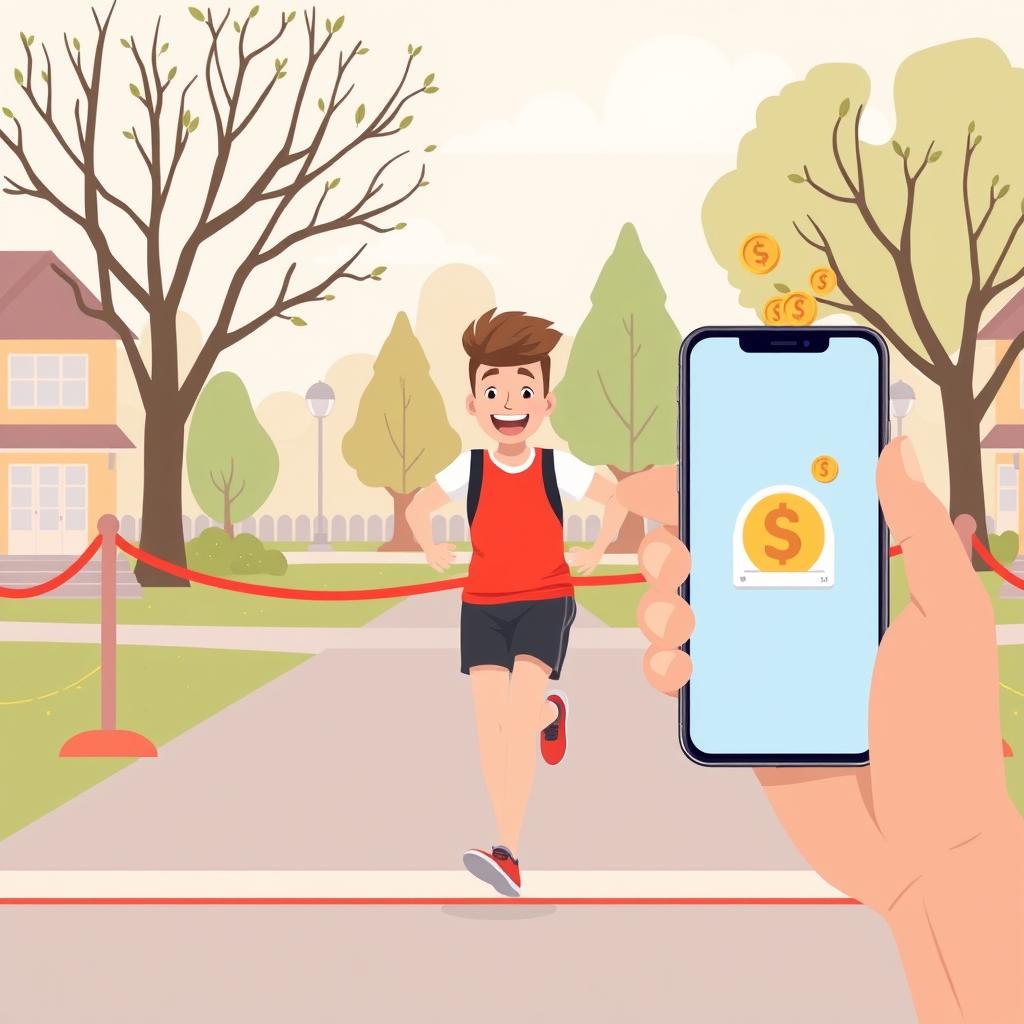
    Apps like Geowill have built this mechanism directly into the running experience through what they call a “burned bridges mission” — where you deposit real money, set a distance goal, and either earn it back by completing the goal or forfeit it to a shared pool for successful runners. It’s a nearly textbook application of commitment device psychology, and it’s exactly why this approach outperforms every “streaks” or badge-only system in the long run.

    The Power of Hyper-Local Social Proof 🏘️

    Motivation research consistently shows that our behavior is far more influenced by what people near us do than by global statistics or celebrity examples. This is called the social proof effect, and it works on proximity. Knowing that millions of people run marathons worldwide does almost nothing for your motivation. Knowing that your neighbor three blocks over ran 18 kilometers this week and is now ranked first in your district? That does something.

    There’s a specific psychological mechanism here called the similarity heuristic. We calibrate what’s possible for us based on people we perceive as similar to ourselves. When a world-class athlete runs a sub-three-hour marathon, most people’s brain quietly files that under “not relevant to me.” But when someone your age, in your neighborhood, on streets you recognize, is logging meaningful runs and earning community recognition — the gap between them and you suddenly feels closeable.

    This is why neighborhood-scale leaderboards and real-time runner visibility features are genuinely useful motivational tools, not just social media gimmicks. Seeing a small cluster of active runners in your immediate area creates a local norm. And humans are deeply, almost automatically, norm-following creatures. Once running in your neighborhood feels like something people here do, the activation energy to step outside drops considerably.

    The social features that actually move the needle are the granular ones: real-time local maps, district rankings, club runs with people from nearby streets. The broader the social scale, the less motivating it becomes. A global leaderboard where you’re ranked 847,203rd is demoralizing. A neighborhood leaderboard where you’re ranked 12th and climbing is a completely different experience.

    Progression Systems and the Zeigarnik Effect 🎮

    There’s a reason you feel slightly uncomfortable leaving a TV episode paused at the 70 percent mark. The Zeigarnik effect, named after Soviet psychologist Bluma Zeigarnik, describes the brain’s tendency to fixate on incomplete tasks more than completed ones. Your working memory literally stays open on unfinished goals like a browser tab you can’t quite close.

    Well-designed progression systems weaponize this. When your XP bar is sitting at 70 percent of the way to the next level, your brain experiences that as an open loop — a mild but persistent cognitive tension that pushes toward closure. Closing it feels good. Leaving it open feels subtly wrong.

    This is why pace zones, interval timers, and structured audio coaching work better as a bundle than as isolated features. Each one creates a small completion event within a single run. You finished the 90-second high-intensity interval. You hit the target pace zone for 10 consecutive minutes. You reached the checkpoint. Each micro-completion fires a small reward signal, turning a 40-minute run into a sequence of wins rather than a single long endurance test.

    The tiered reward structure matters here too. When you can visually see that legendary treasures unlock at level 30, and you’re at level 22, the specificity of the gap changes your relationship to the goal. “Keep running” is vague. “Eight more levels” is a project. The human brain handles projects much better than it handles open-ended commitments.

    What This Means for How You Actually Build a Running Habit 🏃

    Let’s put the psychology together into something actionable, whether or not you ever use a gamified app.

    First, attach an immediate reward to every single run, not just the long-term outcome. This can be as simple as a specific podcast episode you only let yourself hear while running, or a coffee from a particular place you only visit on run days. The reward needs to be immediate, concrete, and genuinely appealing to you.

    Second, use commitment devices. Tell someone publicly what you’re going to do and attach a real consequence to failure. Even informal social commitment — texting a friend your goal for the week — increases follow-through significantly. Financial stakes work best, but any form of public commitment helps.

    Third, make your social comparison local. Find out who in your neighborhood or workplace is running. Even one or two people running the same streets as you makes a measurable difference. The proximity matters more than the size of the community.

    Fourth, design for micro-completions. Don’t think of a run as one 30-minute thing. Break it into intervals, checkpoints, pace targets. Each small win counts neurologically, and accumulating small wins across a session changes how your brain files the experience afterward. You don’t remember “that was hard.” You remember “I hit every split.”

    The runners who actually stick with it long-term almost never rely on willpower or discipline alone. They’ve built environmental structures — social accountability, variable rewards, concrete short-term incentives, specific goals — that reduce the cost of showing up and increase the immediate payoff of doing so.

    Gamification isn’t a cheat code or a gimmick. It’s a systematic redesign of the reward architecture around a behavior your brain would otherwise deprioritize. When an app like Geowill puts a treasure location half a mile from your front door and real money on the line if you don’t hit your monthly target, it isn’t making running easier. It’s making the decision to run easier — which turns out to be the only thing that actually matters.

    You already know running is good for you. Your brain already knows that. The part that needs convincing isn’t your rational mind — it’s your reward system. And now you know exactly how to speak its language.